

Dec 17, 2025 Detailed New DP-420 Exam Questions for Concept Clearance
DP-420 Exam Preparation Material with New DP-420 Dumps Questions.
Microsoft DP-420 certification exam is aimed at software engineers, application developers, database administrators, and architects who are responsible for designing and implementing cloud-native applications. DP-420 exam measures the candidate's ability to design, implement, and manage cloud-native applications using Azure Cosmos DB. DP-420 exam covers a wide range of topics, including data modeling, partitioning, indexing, querying, and scaling. Candidates will also be required to demonstrate their knowledge of Azure Cosmos DB's multi-model capabilities, including support for SQL, MongoDB, Cassandra, and Azure Table storage APIs.
Microsoft DP-420 exam is suitable for developers, architects, and IT professionals who work with Azure Cosmos DB. Candidates who pass DP-420 exam will have a thorough understanding of the Azure Cosmos DB architecture, the design principles of cloud-native applications, and the best practices for implementing and deploying them.
Microsoft DP-420 (Designing and Implementing Cloud-Native Applications Using Microsoft Azure Cosmos DB) certification exam is a valuable credential for professionals who want to demonstrate their expertise in designing and implementing cloud-native applications using Microsoft Azure Cosmos DB. Designing and Implementing Cloud-Native Applications Using Microsoft Azure Cosmos DB certification exam is designed for developers who have experience with cloud computing, distributed systems, and NoSQL databases.
NEW QUESTION # 14
You have an Azure Cosmos DB container named owners. Each item in owners represents an owner and their pets. The following is a sample of the JSON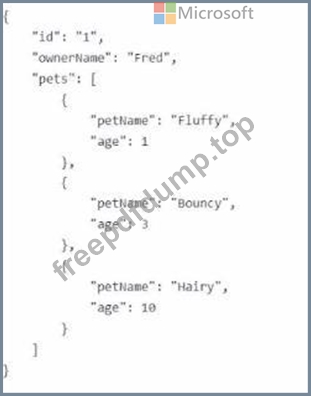
You are writing a query that will retrieve the average age of each pet owned by each owner, il the pet is older than two years.
How should you complete the query? To answer, drag the appropriate values to the correct targets. Each value may be used once, more than once, or not at all. You may need to drag the split bar between panes 01 scroll to view content.
NOTE: Each correct selection is worth one point.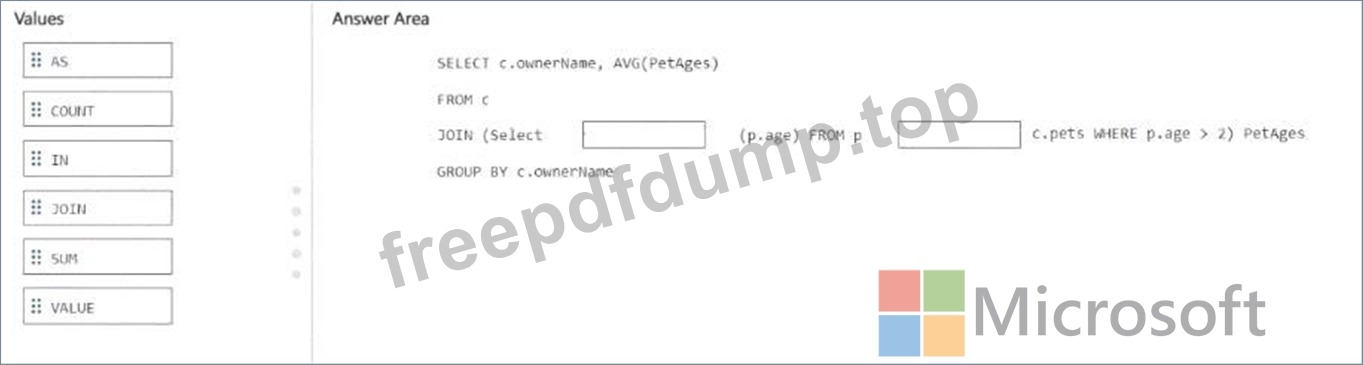
Answer:
Explanation: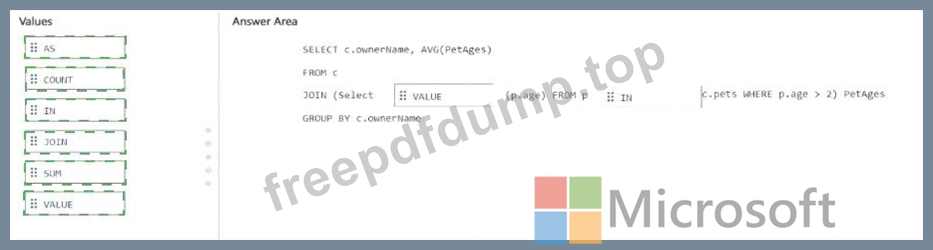
Explanation: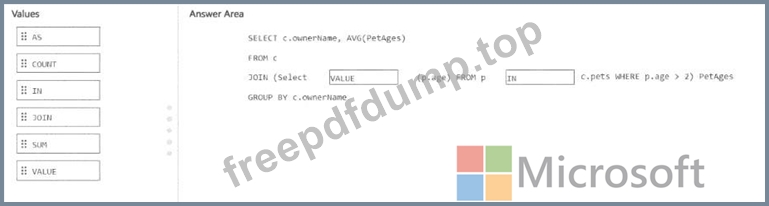
NEW QUESTION # 15
You have an Azure Cosmos DB Core (SQL) API account named account1.
You have the Azure virtual networks and subnets shown in the following table.
The vnet1 and vnet2 networks are connected by using a virtual network peer.
The Firewall and virtual network settings for account1 are configured as shown in the exhibit.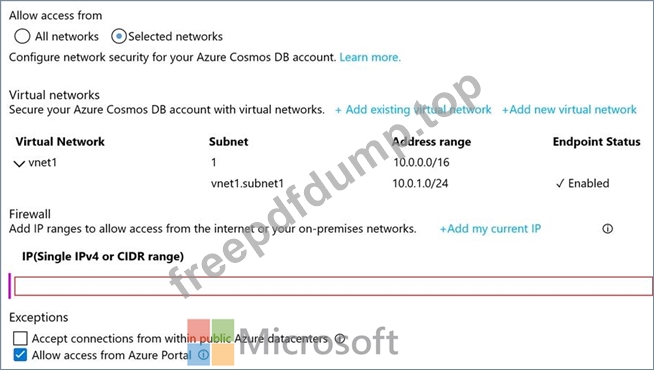
For each of the following statements, select Yes if the statement is true. Otherwise, select No.
NOTE: Each correct selection is worth one point.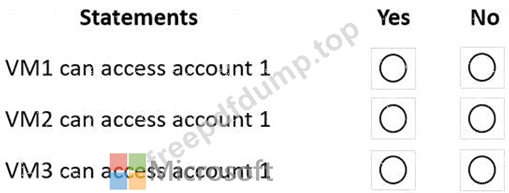
Answer:
Explanation: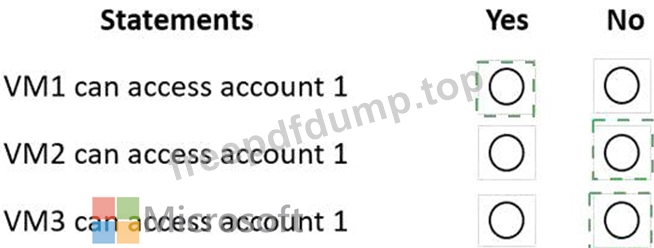
Explanation: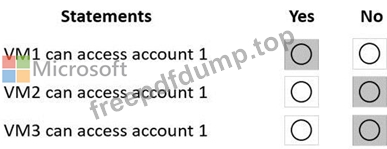
Box 1: Yes
VM1 is on vnet1.subnet1 which has the Endpoint Status enabled.
Box 2: No
Only virtual network and their subnets added to Azure Cosmos account have access. Their peered VNets cannot access the account until the subnets within peered virtual networks are added to the account.
Box 3: No
Only virtual network and their subnets added to Azure Cosmos account have access.
Reference: https://docs.microsoft.com/en-us/azure/cosmos-db/how-to-configure-vnet-service-endpoint
NEW QUESTION # 16
You have an application that queries an Azure Cosmos 06 for NoSQL account.
You discover that the following two queries run frequently,
You need to minimize the request units (RUs) consumed by reads and writes. What should you create?
- A. a composite index for (name ASC, time stamp DESC)
- B. a composite index for (name DESC, time stamp ASC)
- C. a composite index for (name ASC, time stamp ASC)
- D. a composite index for (name ASC time stamp ASC) and a composite index for (name, time stamp disc)
Answer: C
NEW QUESTION # 17
You have an application that queries an Azure Cosmos 06 for NoSQL account.
You discover that the following two queries run frequently,
You need to minimize the request units (RUs) consumed by reads and writes. What should you create?
- A. a composite index for (name ASC, time stamp DESC)
- B. a composite index for (name DESC, time stamp ASC)
- C. a composite index for (name ASC, time stamp ASC)
- D. a composite index for (name ASC time stamp ASC) and a composite index for (name, time stamp disc)
Answer: C
NEW QUESTION # 18
You have an Azure Cosmos DB for NoSQL account that has multiple write regions.
You need to receive an alert when requests that target the database exceed the available request units per second (RU/s).
Which Azure Monitor signal should you use?
- A. Region Removed
- B. Metadata Requests
- C. Provisioned Throughput
- D. Data Usage
Answer: C
Explanation:
Azure Monitor is a service that provides comprehensive monitoring for Azure resources, including Azure Cosmos DB. You can use Azure Monitor to collect, analyze, and alert onmetrics and logs from your Azure Cosmos DB account. You can create alerts for Azure Cosmos DB using Azure Monitor based on the metrics, activity log events, or Log Analytics logs on your account1.
For your scenario, if you want to receive an alert when requests that target the database exceed the available request units per second (RU/s), you should use the Document Quota metric. This metric measures the percentage of RU/s consumed by your account or container. You can create an alert rule on this metric from the Azure portal by following these steps2:
* In the Azure portal, select the Azure Cosmos DB account you want to monitor.
* Under the Monitoring section of the sidebar, select Alerts, and then select New alert rule.
* In the Create alert rule pane, fill out the Scope section by selecting your subscription name and resource type (Azure Cosmos DB accounts).
* In the Condition section, select Add condition and choose Document Quota from the list of signals.
* In the Configure signal logic pane, specify the threshold value and operator for your alert condition. For example, you can choose Greater than or equal to 90 as the threshold value and operator to receive an alert when your RU/s consumption reaches 90% or more of your provisioned throughput.
* In the Alert rule details section, specify a name and description for your alert rule.
* In the Actions section, select Add action group and choose how you want to receive notifications for your alert. For example, you can choose Email/SMS/Push/Voice as an action type and enter your email address or phone number as a receiver.
* Review your alert rule settings and select Create alert rule to save it.
NEW QUESTION # 19
You plan to store order data in Azure Cosmos DB for NoSQL account. The data contains information about orders and their associated items.
You need to develop a model that supports order read operations. The solution must minimize the number or requests.
- A. Create a database for orders and a database for order items.
- B. Create a single database that contains one container. Store orders and order items in separate documents in the container.
- C. Create a single database that contains one container. Create a separate document for each order and embed the order items into the order documents.
- D. Create a single database that contains a container for order and a container for order items.
Answer: C
Explanation:
Azure Cosmos DB is a multi-model database that supports various data models, such as documents, key-value, graph, and column-family3. The core content-model of Cosmos DB's database engine is based on atom-record-sequence (ARS), which allows it to store and query different types of data in a flexible and efficient way3.
To develop a model that supports order read operations and minimizes the number of requests, you should consider the following factors:
* The size and shape of your data
* The frequency and complexity of your queries
* The latency and throughput requirements of your application
* The trade-offs between storage efficiency and query performance
Based on these factors, one possible model that you could implement is B. Create a single database that contains one container. Create a separate document for each order and embed the order items into the order documents.
This model has the following advantages:
* It stores orders and order items as self-contained documents that can be easily retrieved by order ID1.
* It avoids storing redundant data or creating additional containers for order items1.
* It allows you to view the order history of a customer with simple queries1.
* It leverages the benefits of embedding data, such as reducing the number of requests, improving query performance, and simplifying data consistency2.
This model also has some limitations, such as:
* It may not be suitable for some order items that have data that is greater than 2 KB, as it could exceed the maximum document size limit of 2 MB2.
* It may not be optimal for scenarios where order items need to be queried independently from orders or aggregated by other criteria2.
* It may not support transactions across multiple orders or customers, as transactions are scoped to a single logical partition2.
Depending on your specific use case and requirements, you may need to adjust this model or choose a different one. For example, you could use a hybrid data model that combines embedding and referencing data2
, or you could use a graph data model that expresses entities and relationships as vertices and edges.
NEW QUESTION # 20
You have a container m an Azure Cosmos DB for NoSQL account.
Data update volumes are unpredictable.
You need to process the change teed of the container by using a web app that has multiple instances. The change feed will be processed by using the change feed processor from the Azure Cosmos DB SDK. The multiple instances must share the workload.
Which three actions should you perform? Each correct answer presents part of the solution.
NOTE: Each correct selection is worth one point.
- A. Configure the same lease container configuration for all the instances.
- B. Configure a different instance name for each instance.
- C. Configure the same processor name for all the instances.
- D. Configure a different processor name for each instance.
- E. Configure a different lease container configuration for each instance.
- F. Configure the same instance name for all the instances. 13
Answer: A,B,C
NEW QUESTION # 21
You plan to implement con-iot1 and con-iot2.
You need to configure the default Time to Live setting for each container. The solution must meet the loT telemetry requirements.
What should you configure? To answer, select the appropriate options in the answer NOTE: Each correct selection is worth one point.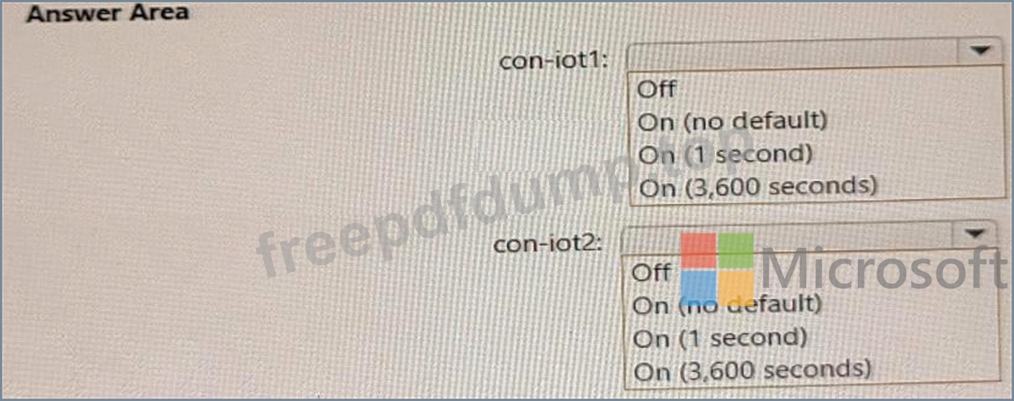
Answer:
Explanation: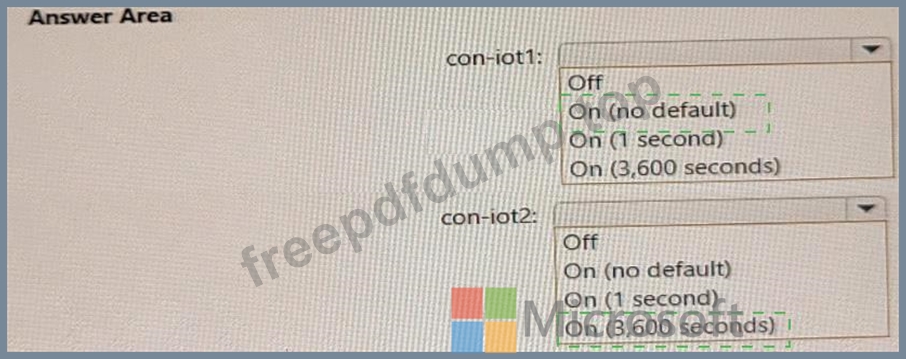
Explanation:
Box 1 = On (no default)For con-iot1, you need to configure the default TTL setting to On (no default), which means that items in this container do not expire by default, but you can override the TTL value on a per-item basis. This meets the requirement of retaining all telemetry data unless overridden1.
Box 2 = On (3600 seconds)For con-iot2, you need to configure the default TTL setting to On (3600 seconds), which means that items in this container will expire 3600 seconds (one hour) after their last modified time. This meets the requirement of deleting all telemetry data older than one hour1.
NEW QUESTION # 22
You need to configure an Apache Kafka instance to ingest data from an Azure Cosmos DB Core (SQL) API account. The data from a container named telemetry must be added to a Kafka topic named iot. The solution must store the data in a compact binary format.
Which three configuration items should you include in the solution? Each correct answer presents part of the solution.
NOTE: Each correct selection is worth one point.
- A. "connector.class": "com.azure.cosmos.kafka.connect.source.CosmosDBSinkConnector"
- B. "key.converter": "org.apache.kafka.connect.json.JsonConverter"
- C. "connect.cosmos.containers.topicmap": "iot"
- D. "connect.cosmos.containers.topicmap": "iot#telemetry"
- E. "key.converter": "io.confluent.connect.avro.AvroConverter"
- F. "connector.class": "com.azure.cosmos.kafka.connect.source.CosmosDBSourceConnector"
Answer: A,D,E
Explanation:
Explanation
C: Avro is binary format, while JSON is text.
F: Kafka Connect for Azure Cosmos DB is a connector to read from and write data to Azure Cosmos DB. The Azure Cosmos DB sink connector allows you to export data from Apache Kafka topics to an Azure Cosmos DB database. The connector polls data from Kafka to write to containers in the database based on the topics subscription.
D: Create the Azure Cosmos DB sink connector in Kafka Connect. The following JSON body defines config for the sink connector.
Extract:
"connector.class": "com.azure.cosmos.kafka.connect.sink.CosmosDBSinkConnector",
"key.converter": "org.apache.kafka.connect.json.AvroConverter"
"connect.cosmos.containers.topicmap": "hotels#kafka"
Reference:
https://docs.microsoft.com/en-us/azure/cosmos-db/sql/kafka-connector-sink
https://www.confluent.io/blog/kafka-connect-deep-dive-converters-serialization-explained/
NEW QUESTION # 23
You have an Azure Cosmos DB for NoSQL account named accounts1.
You plan to implement the integrated cache for account1.
You need to configure the connectivity mode and the consistency level for requests that target account1. The solution must maximize consistency while using the integrated cache.
What should you configure? To answer, select the appropriate options in the answer area.
NOTE: Each correct selection is worth one point.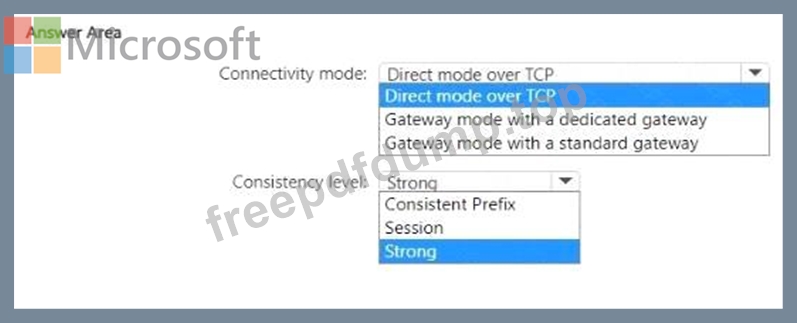
Answer:
Explanation: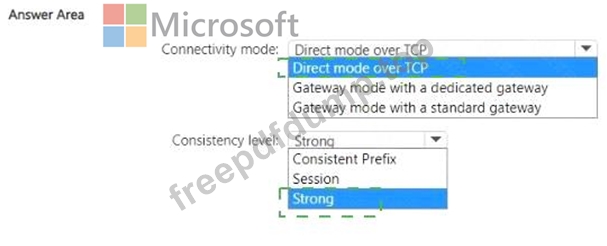
Explanation: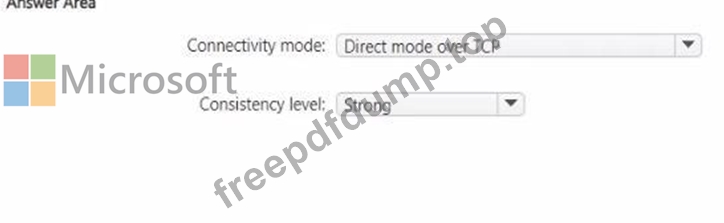
NEW QUESTION # 24
You have an Azure Cosmos DB Core (SQL) API account named account1.
You have the Azure virtual networks and subnets shown in the following table.
The vnet1 and vnet2 networks are connected by using a virtual network peer.
The Firewall and virtual network settings for account1 are configured as shown in the exhibit.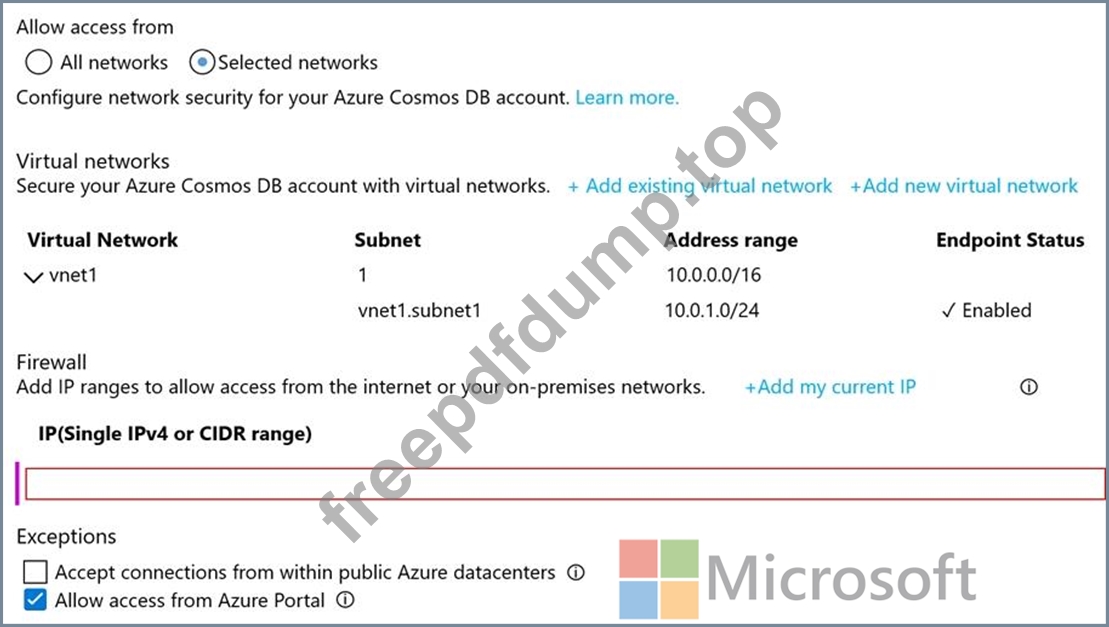
For each of the following statements, select Yes if the statement is true. Otherwise, select No.
NOTE: Each correct selection is worth one point.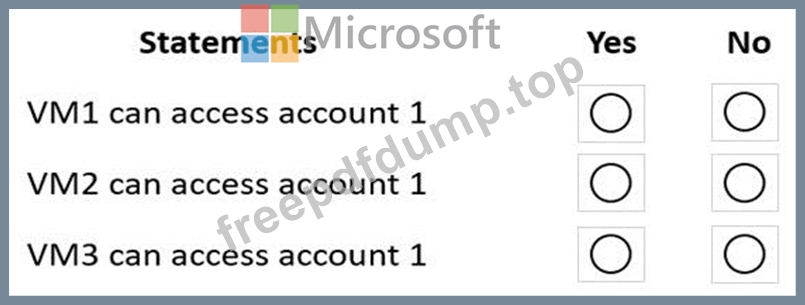
Answer:
Explanation: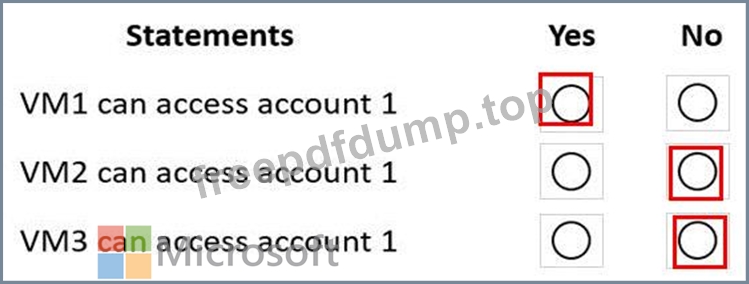
NEW QUESTION # 25
You have an app that stores data in an Azure Cosmos DB Core (SQL) API account The app performs queries that return large result sets.
You need to return a complete result set to the app by using pagination. Each page of results must return 80 items.
Which three actions should you perform in sequence? To answer, move the appropriate actions from the list of actions to the answer area and arrange them in the correct order.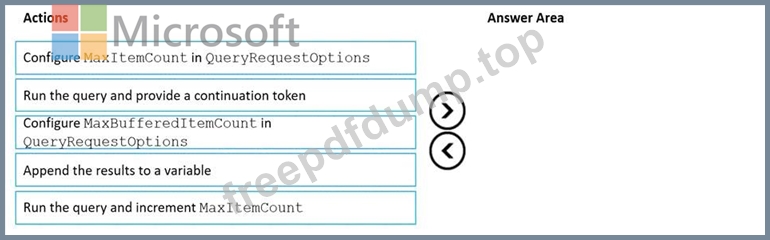
Answer:
Explanation: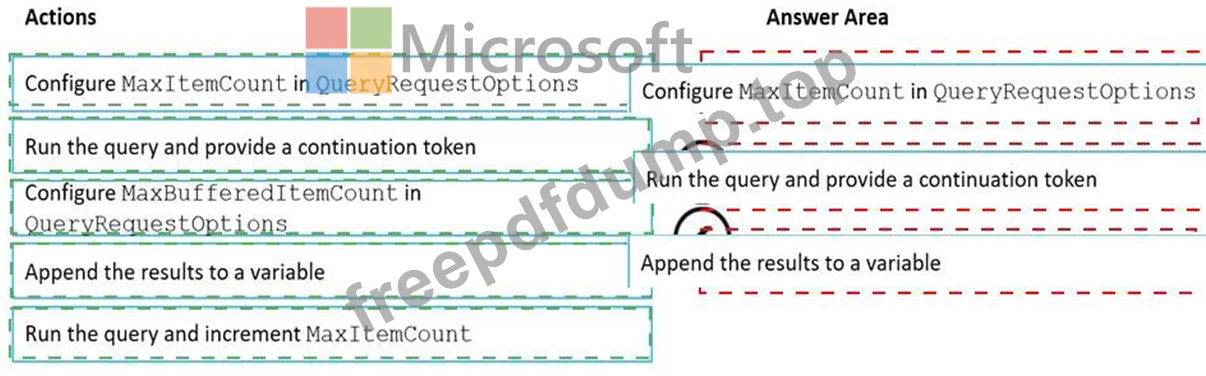
Explanation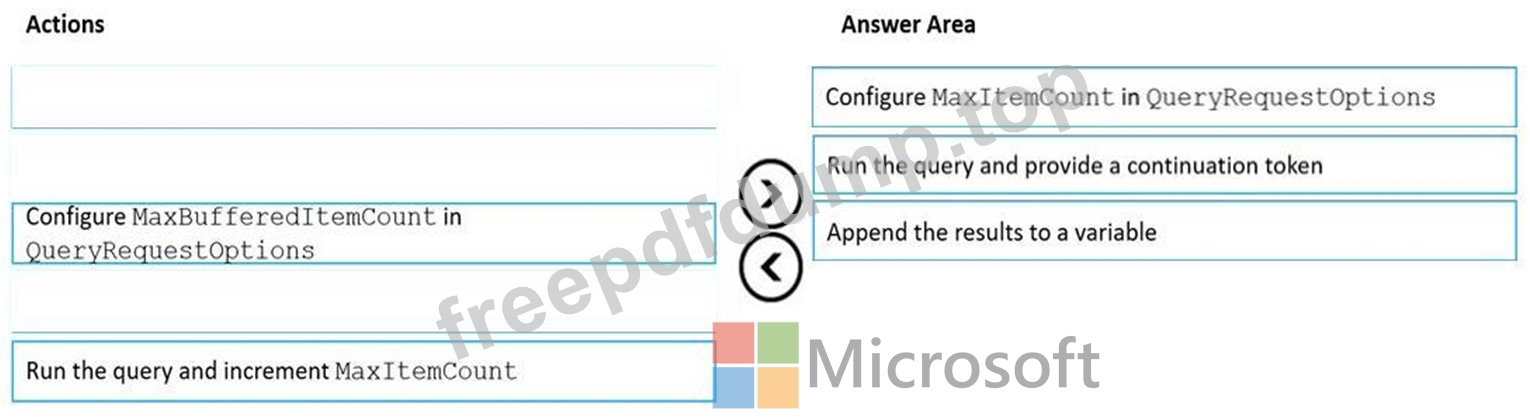
Step 1: Configure the MaxItemCount in QueryRequestOptions
You can specify the maximum number of items returned by a query by setting the MaxItemCount. The MaxItemCount is specified per request and tells the query engine to return that number of items or fewer.
Box 2: Run the query and provide a continuation token
In the .NET SDK and Java SDK you can optionally use continuation tokens as a bookmark for your query's progress. Azure Cosmos DB query executions are stateless at the server side and can be resumed at any time using the continuation token.
If the query returns a continuation token, then there are additional query results.
Step 3: Append the results to a variable
Reference: https://docs.microsoft.com/en-us/azure/cosmos-db/sql/sql-query-pagination
NEW QUESTION # 26
You have an Azure Cosmos DB for NoSQL account.
You need to create an Azure Monitor query that lists recent modifications to the regional failover policy.
Which Azure Monitor table should you query?
- A. CDBQueryRunTimeStatistics
- B. CDBDataPlaneRequests
- C. CDBControlPlaneRequests
- D. CDBPartitionKeyStatistics
Answer: C
NEW QUESTION # 27
You have an Azure Cosmos DB for NoSQL container named Contacts that is configured as shown in the following exhibit.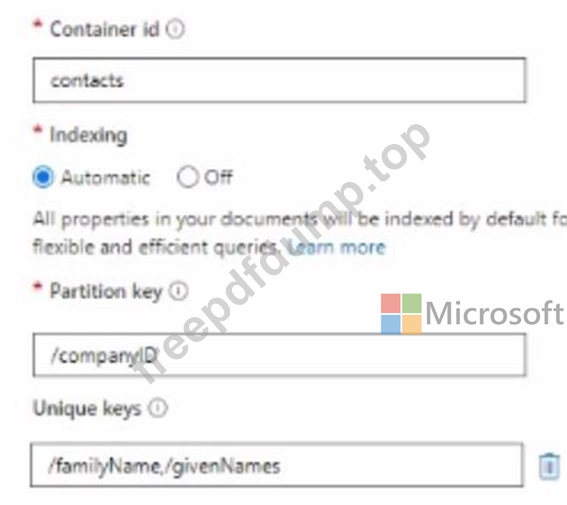
Contacts contains the items shown in the following table.
To Contacts, you plan to insert the items shown in the following table.
For each of the following statements select Yes if the statement is true. Otherwise, select No.
NOTE: Each correct selection is worth one point.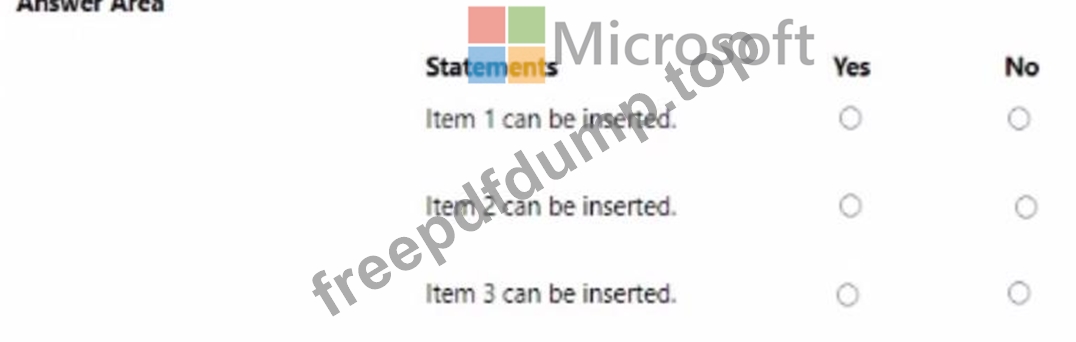
Answer:
Explanation: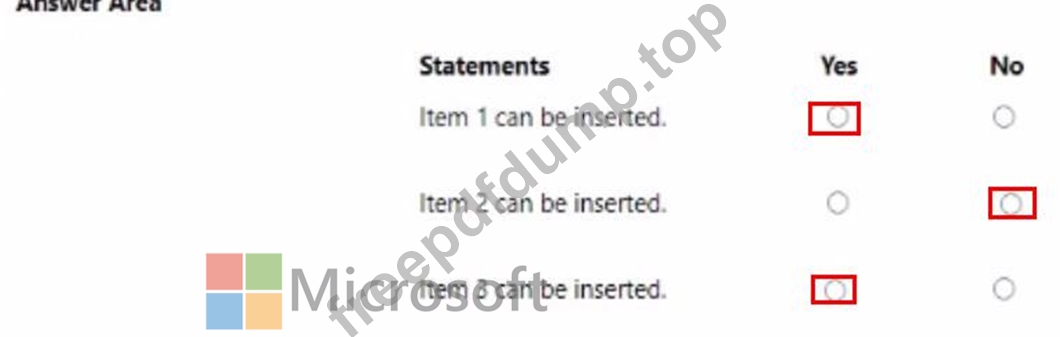
NEW QUESTION # 28
You plan to create an Azure Cosmos DB for NoSQL account that will have a single write region and three read regions. You need to set the consistency level for the account. The solution must meet the following requirements:
* In the write region, writes must replicate synchronously across at least three replicas.
* In the read regions, reads must see writes in order for transactional batches.
* Throughput for reads and writes must be maximized.
Which consistency level should you select?
- A. Eventual
- B. Bounded Staleness
- C. Strong
- D. Consistent Prefix
Answer: D
NEW QUESTION # 29
You provision Azure resources by using the following Azure Resource Manager (ARM) template.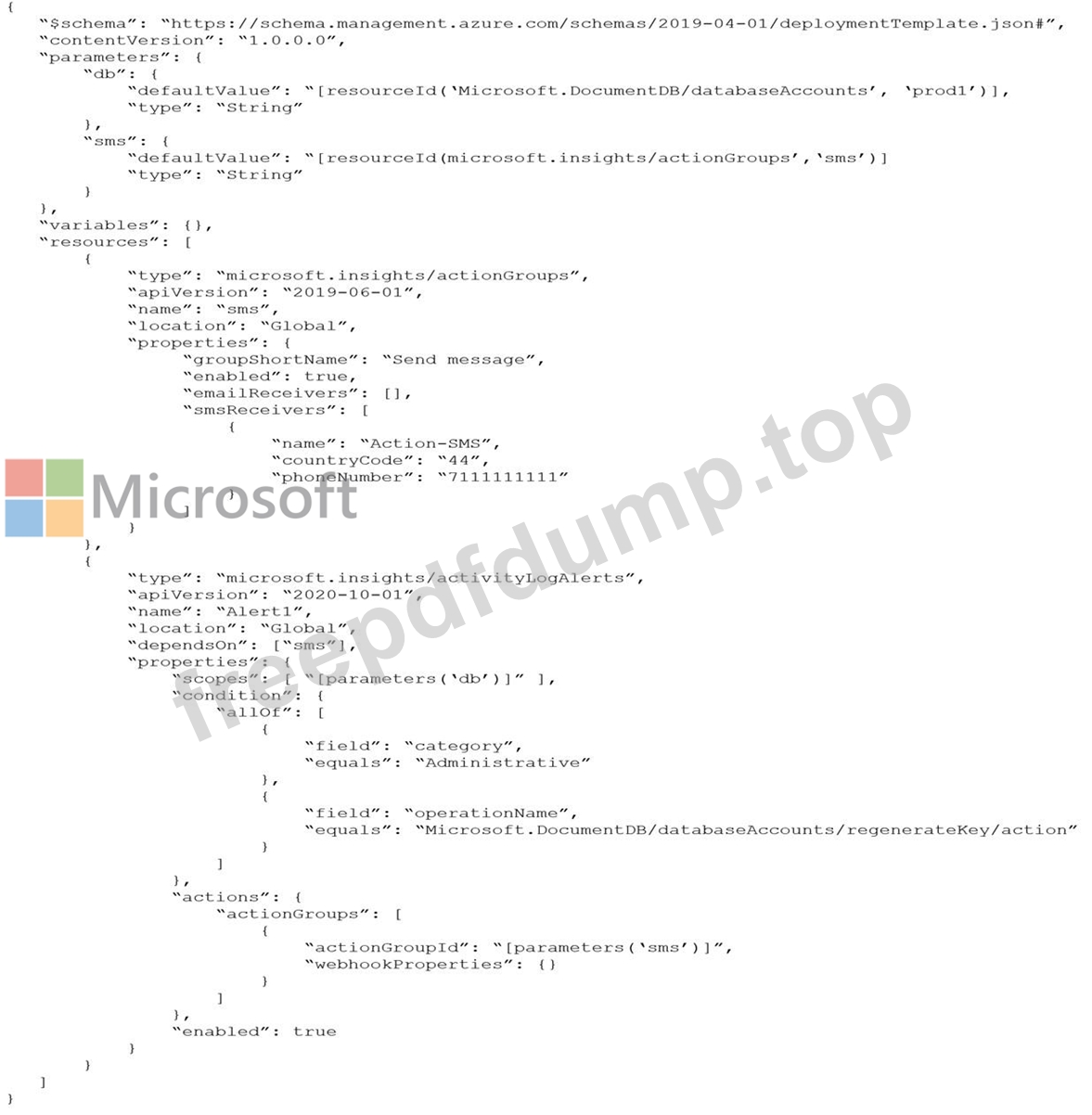
For each of the following statements, select Yes if the statement is true. Otherwise, select No.
NOTE: Each correct selection is worth one point.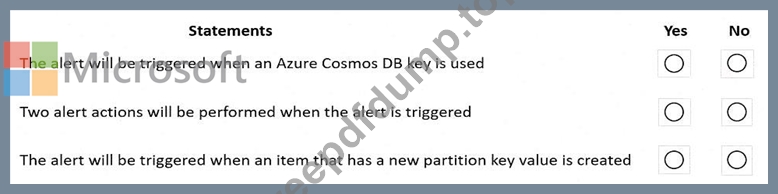
Answer:
Explanation: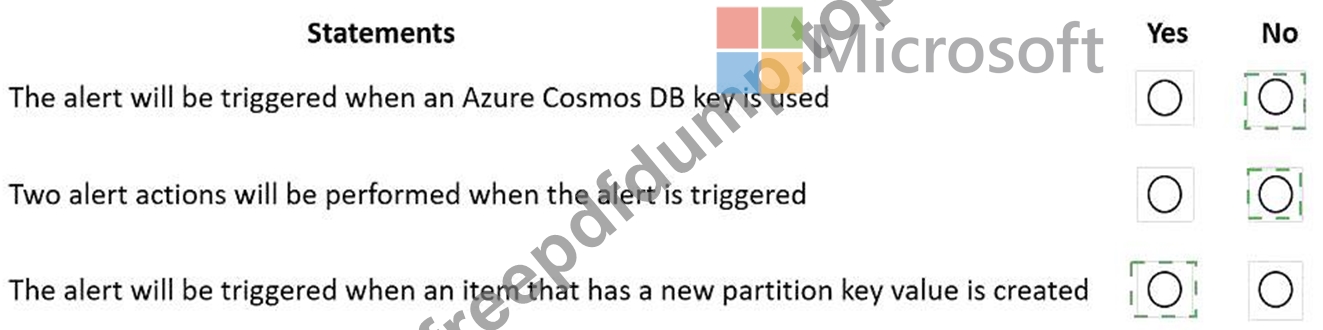
Explanation: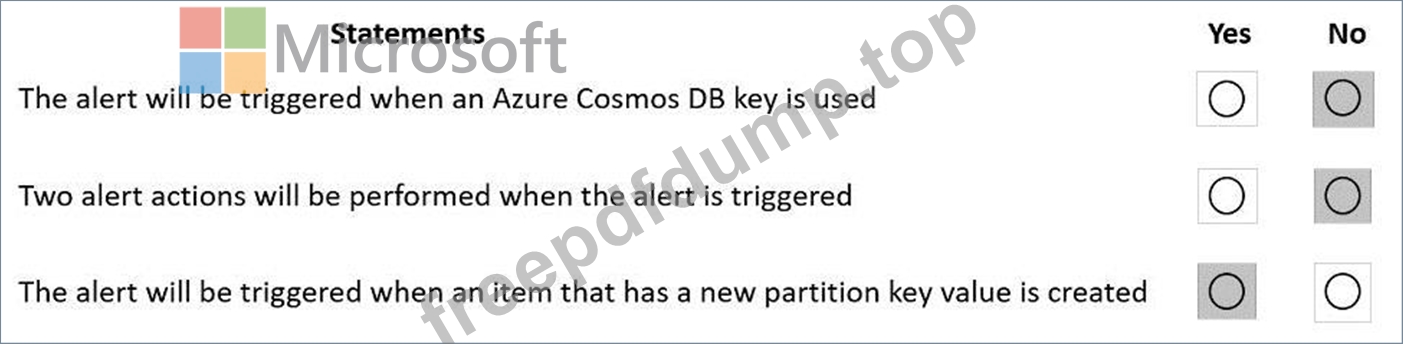
Box 1: No
An alert is triggered when the DB key is regenerated, not when it is used.
Note: The az cosmosdb keys regenerate command regenerates an access key for a Azure Cosmos DB database account.
Box 2: No
Only an SMS action will be taken.
Emailreceivers is empty so no email action is taken.
Box 3: Yes
Yes, an alert is triggered when the DB key is regenerated.
Reference: https://docs.microsoft.com/en-us/cli/azure/cosmosdb/keys
NEW QUESTION # 30
You are implementing an Azure Data Factory data flow that will use an Azure Cosmos DB (SQL API) sink to write a dataset. The data flow will use 2,000 Apache Spark partitions.
You need to ensure that the ingestion from each Spark partition is balanced to optimize throughput.
Which sink setting should you configure?
- A. Collection action
- B. Batch size
- C. Write throughput budget
- D. Throughput
Answer: B
NEW QUESTION # 31
You have an Azure Cosmos DB database named databaset contains a container named container1. The container1 container store product data and has the following indexing policy.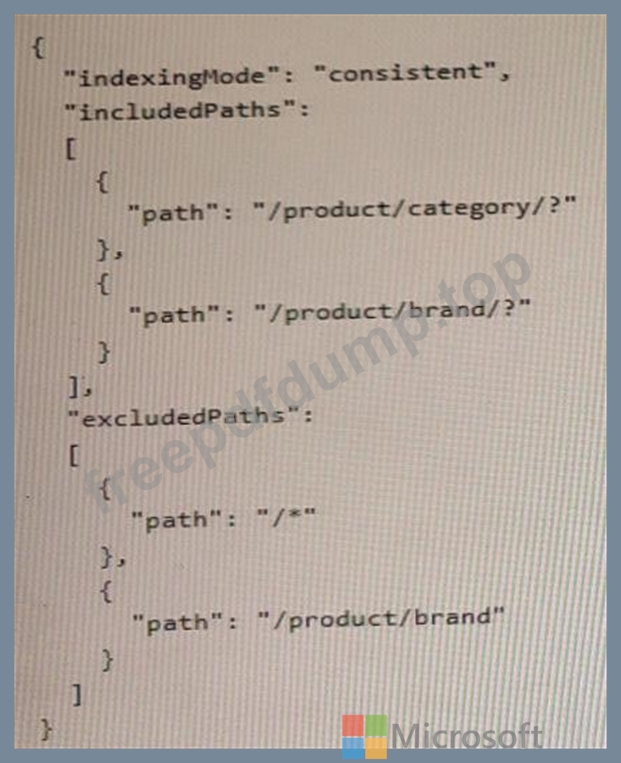
Which path will be indexed?
- A. /product/[ ]/category
- B. /product/brand/tailspin
- C. /product/category
- D. /product/brand
Answer: D
Explanation:
The indexing policy has an includedPaths array that contains only one path: /product/brand/? . This means that only the properties under /product/brand will be indexed. The ? symbol indicates that only scalar values will be indexed, not arrays or objects1.
The excludedPaths array contains a single path: /* . This means that all other properties will be excluded from indexing. The * symbol indicates a wildcard that matches any property name1.
Therefore, the paths /product/category , /product/[ ]/category , and /product/brand/tailspin will not be indexed.
NEW QUESTION # 32
You have a container named container1 in an Azure Cosmos DB Core (SQL) API account.
The following is a sample of a document in container1.
{
"studentId": "631282",
"firstName": "James",
"lastName": "Smith",
"enrollmentYear": 1990,
"isActivelyEnrolled": true,
"address": {
"street": "",
"city": "",
"stateProvince": "",
"postal": "",
}
}
The container1 container has the following indexing policy.
{
"indexingMode": "consistent",
"includePaths": [
{
"path": "/*"
},
{
"path": "/address/city/?"
}
],
"excludePaths": [
{
"path": "/address/*"
},
{
"path": "/firstName/?"
}
]
}
For each of the following statements, select Yes if the statement is true. Otherwise, select No.
NOTE: Each correct selection is worth one point.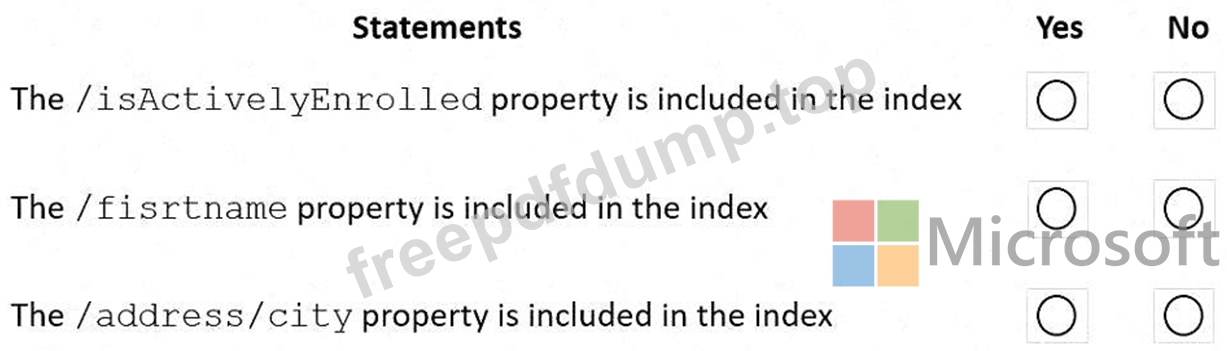
Answer:
Explanation: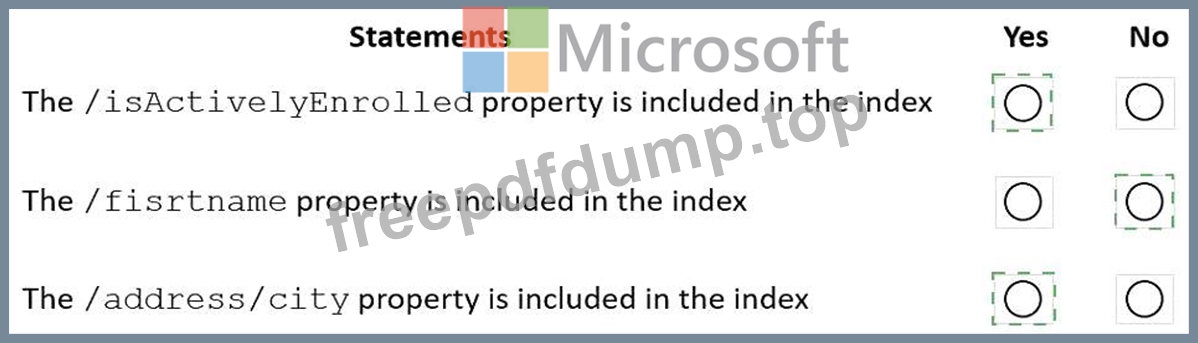
Explanation: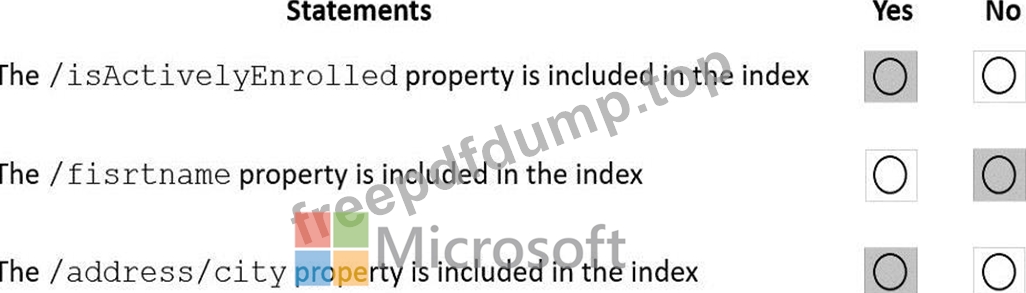
Box 1: Yes
"path": "/*" is in includePaths.
Include the root path to selectively exclude paths that don't need to be indexed. This is the recommended approach as it lets Azure Cosmos DB proactively index any new property that may be added to your model.
Box 2: No
"path": "/firstName/?" is in excludePaths.
Box 3: Yes
"path": "/address/city/?" is in includePaths
Reference: https://docs.microsoft.com/en-us/azure/cosmos-db/index-policy
NEW QUESTION # 33
Note: This question is part of a series of questions that present the same scenario. Each question in the series contains a unique solution that might meet the stated goals. Some question sets might have more than one correct solution, while others might not have a correct solution.
After you answer a question in this section, you will NOT be able to return to it. As a result, these questions will not appear in the review screen.
You have a container named container1 in an Azure Cosmos DB Core (SQL) API account.
You need to make the contents of container1 available as reference data for an Azure Stream Analytics job.
Solution: You create an Azure function that uses Azure Cosmos DB Core (SQL) API change feed as a trigger and Azure event hub as the output.
Does this meet the goal?
- A. Yes
- B. No
Answer: B
Explanation:
The Azure Cosmos DB change feed is a mechanism to get a continuous and incremental feed of records from an Azure Cosmos container as those records are being created or modified. Change feed support works by listening to container for any changes. It then outputs the sorted list of documents that were changed in the order in which they were modified.
The following diagram represents the data flow and components involved in the solution:
NEW QUESTION # 34
You have an Azure Cosmos DB database that contains a container named container 1. The container1 container is configured with a maximum of 20,000 RU/s and currently contains 240 GB of data.
You need to estimate the costs of container1 based on the current usage.
How many RU/s will be charged?
- A. 0
- B. 20,000
- C. 1
- D. 4.000
Answer: D
NEW QUESTION # 35
......
DP-420 2025 Training With 146 QA's: https://pass4sures.freepdfdump.top/DP-420-valid-torrent.html
