

Fortinet FCSS_SASE_AD-24 Exam Preparation Guide and PDF Download
Verified & Correct FCSS_SASE_AD-24 Practice Test Reliable Source Jan 19, 2026 Updated
Fortinet FCSS_SASE_AD-24 Exam Syllabus Topics:
| Topic | Details |
|---|---|
| Topic 1 |
|
| Topic 2 |
|
| Topic 3 |
|
| Topic 4 |
|
NEW QUESTION # 16
Which VDOM type needs to be configured on the FortiGate Secure Edge to establish a layer 2 network between itself and FortiSASE?
Response:
- A. Traffic
- B. Transparent
- C. Admin
- D. LAN-Extension
Answer: D
NEW QUESTION # 17
Which command is used in FortiOS to monitor the traffic distribution in Secure SD-WAN?
Response:
- A. get router info sdwan
- B. get system traffic-distribution
- C. diagnose sys sdwan status
- D. diagnose debug sdwan
Answer: C
NEW QUESTION # 18
An organization needs to resolve internal hostnames using its internal rather than public DNS servers for remotely connected endpoints. Which two components must be configured on FortiSASE to achieve this? (Choose two.)
- A. Split DNS rules
- B. SSL deep inspection
- C. DNS filter
- D. Split tunnelling destinations
Answer: A,B
Explanation:
To resolve internal hostnames using internal DNS servers for remotely connected endpoints, the following two components must be configured on FortiSASE:
Split DNS Rules:
Split DNS allows the configuration of specific DNS queries to be directed to internal DNS servers instead of public DNS servers.
This ensures that internal hostnames are resolved using the organization's internal DNS infrastructure, maintaining privacy and accuracy for internal network resources.
Split Tunneling Destinations:
Split tunneling allows specific traffic (such as DNS queries for internal domains) to be routed through the VPN tunnel while other traffic is sent directly to the internet.
By configuring split tunneling destinations, you can ensure that DNS queries for internal hostnames are directed through the VPN to the internal DNS servers.
Reference:
FortiOS 7.2 Administration Guide: Provides details on configuring split DNS and split tunneling for VPN clients.
FortiSASE 23.2 Documentation: Explains the implementation and configuration of split DNS and split tunneling for securely resolving internal hostnames.
NEW QUESTION # 19
During FortiSASE provisioning, how many security points of presence (POPs) need to be configured by the FortiSASE administrator?
- A. 0
- B. 1
- C. 2
- D. 3
Answer: A
Explanation:
https://docs.fortinet.com/document/fortisase/latest/administration-guide/751044/appendix-a-fortisase-data- centers#Number
NEW QUESTION # 20
A customer needs to implement device posture checks for their remote endpoints while accessing the protected server. They also want the TCP traffic between the remote endpoints and the protected servers to be processed by FortiGate.
In this scenario, which three setups will achieve the above requirements? (Choose three.)
- A. Configure private access policies on FortiSASE with ZTNA.
- B. Sync ZTNA tags from FortiSASE to FortiGate.
- C. Configure ZTNA tags on FortiGate.
- D. Configure ZTNA servers and ZTNA policies on FortiGate.
- E. Configure FortiGate as a zero trust network access (ZTNA) access proxy.
Answer: C,D,E
Explanation:
To meet the requirements of implementing device posture checks for remote endpoints and ensuring that TCP traffic between the endpoints and protected servers is processed by FortiGate, the following three setups are necessary:
Configure ZTNA tags on FortiGate (Option A):
ZTNA (Zero Trust Network Access) tags are used to define access control policies based on the security posture of devices. By configuring ZTNA tags on FortiGate, administrators can enforce granular access controls, ensuring that only compliant devices can access protected resources.
Configure FortiGate as a zero trust network access (ZTNA) access proxy (Option B):
FortiGate can act as a ZTNA access proxy, which allows it to mediate and secure connections between remote endpoints and protected servers. This setup ensures that all TCP traffic passes through FortiGate, enabling inspection and enforcement of security policies.
Configure ZTNA servers and ZTNA policies on FortiGate (Option C):
To enable ZTNA functionality, administrators must define ZTNA servers (the protected resources) and create ZTNA policies on FortiGate. These policies determine how traffic is routed, inspected, and controlled based on device posture and user identity.
NEW QUESTION # 21
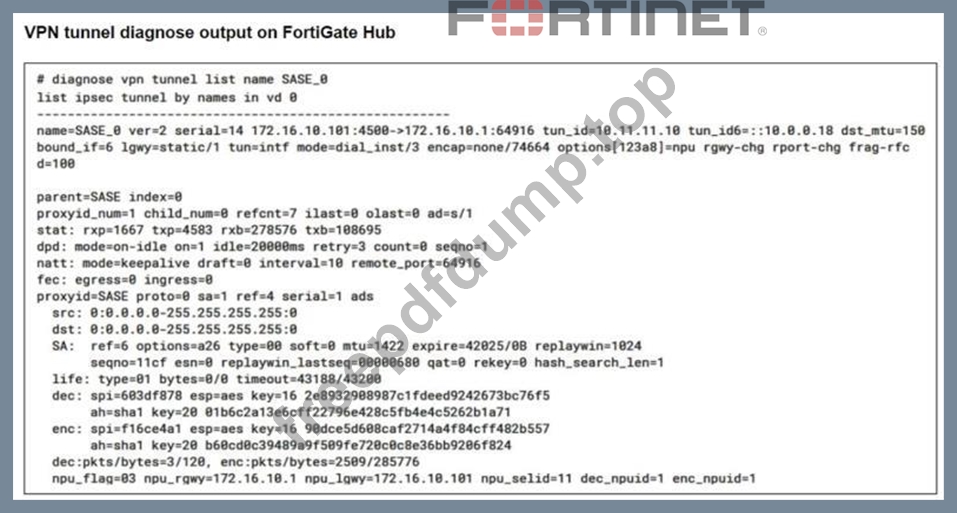
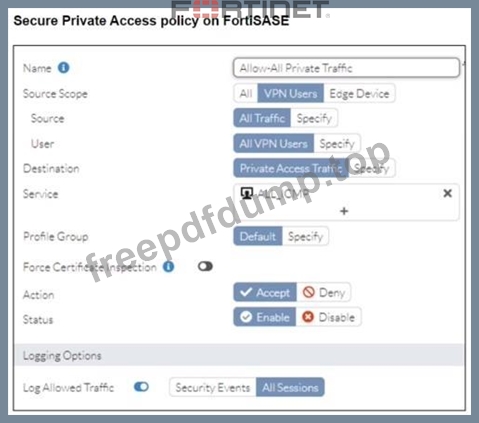
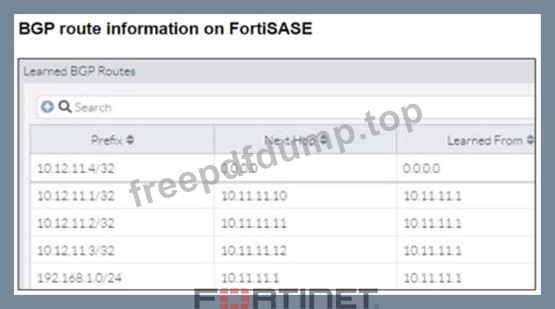
Refer to the exhibits. A FortiSASE administrator is trying to configure FortiSASE as a spoke to a FortiGate hub. The tunnel is up to the FortiGate hub. However, the administrator is not able to ping the Webserver hosted behind the FortiGate hub.
Based on the output, what is the reason for the ping failures?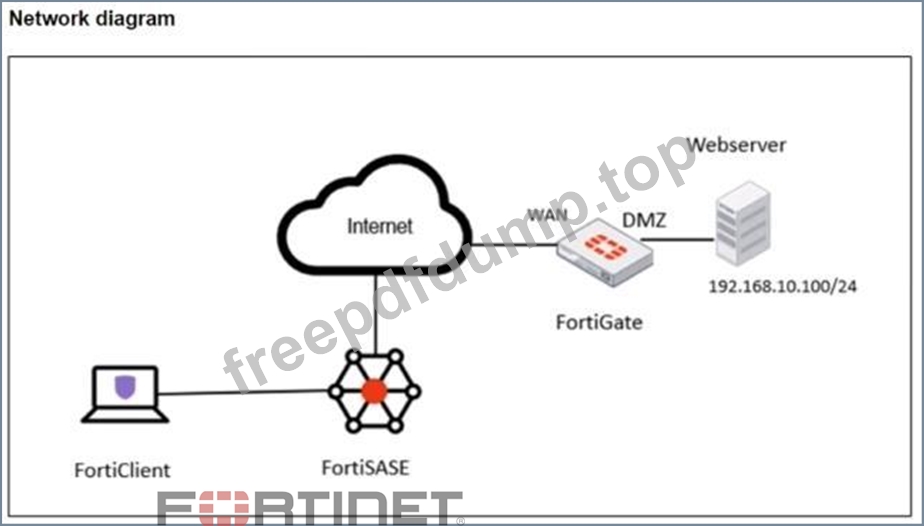
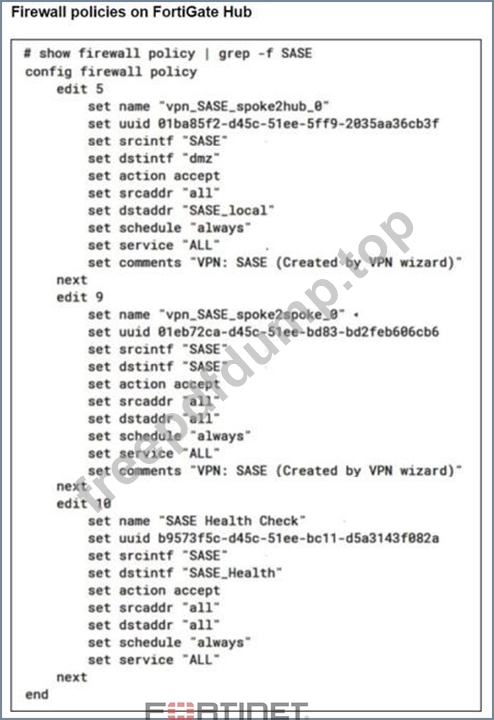
- A. Network address translation (NAT) is not enabled on the spoke-to-hub policy.
- B. The Secure Private Access (SPA) policy needs to allow PING service.
- C. The BGP route is not received.
- D. Quick mode selectors are restricting the subnet.
Answer: C
NEW QUESTION # 22
In which three ways does FortiSASE help organizations ensure secure access for remote workers? (Choose three.)
- A. It uses the identity & access management (IAM) portal to validate the identities of remote workers.
- B. It offers zero trust network access (ZTNA) capabilities.
- C. It enforces granular access policies based on user identities.
- D. It secures traffic from endpoints to cloud applications.
- E. It enforces multi-factor authentication (MFA) to validate remote users.
Answer: B,C,D
Explanation:
FortiSASE provides several features to ensure secure access for remote workers. The following three ways are particularly relevant:
It secures traffic from endpoints to cloud applications (Option B):
FortiSASE secures all traffic between remote endpoints and cloud applications by inspecting it in real time. This includes applying security policies, threat detection, and data protection measures to ensure that traffic is safe and compliant.
It offers zero trust network access (ZTNA) capabilities (Option D):
ZTNA ensures that remote workers are granted access to resources based on strict verification of their identity and device posture. By treating all users and devices as untrusted by default, ZTNA minimizes the risk of unauthorized access and lateral movement within the network.
It enforces granular access policies based on user identities (Option E):
FortiSASE allows administrators to define and enforce fine-grained access policies based on user identities, roles, and other attributes. This ensures that remote workers only have access to the resources they need, reducing the attack surface.
NEW QUESTION # 23
Refer to the exhibits.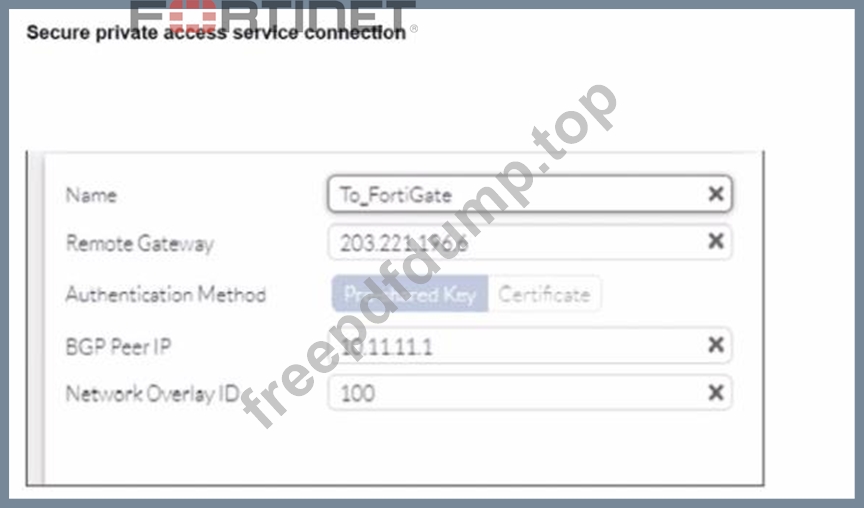
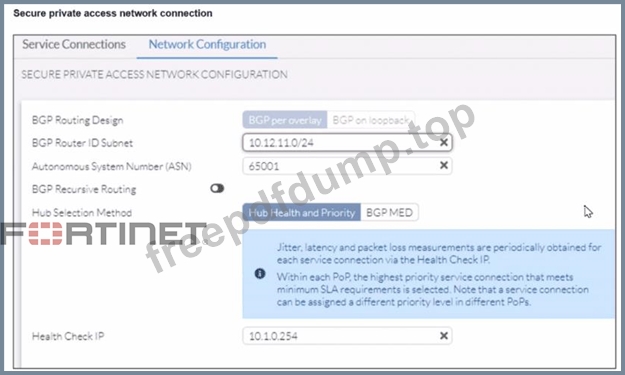
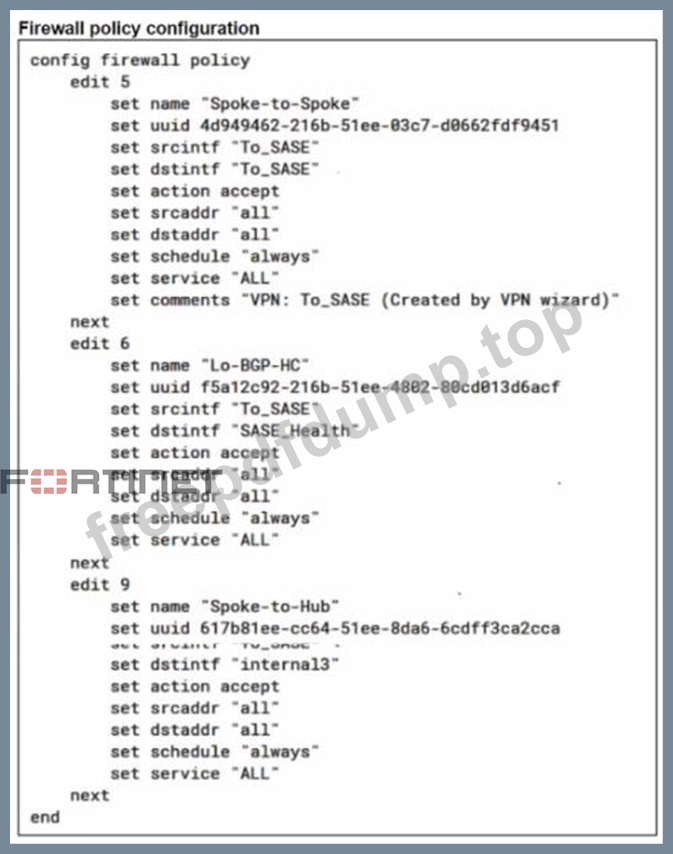
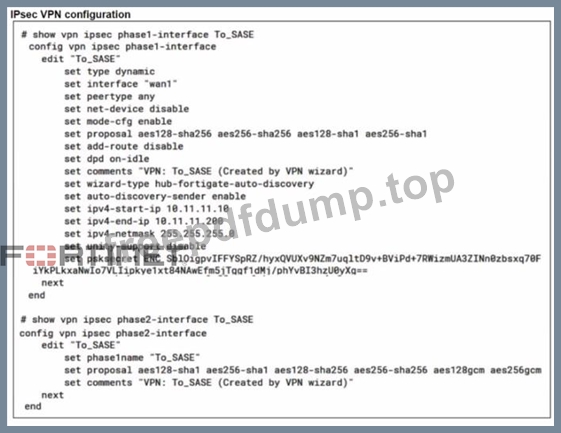
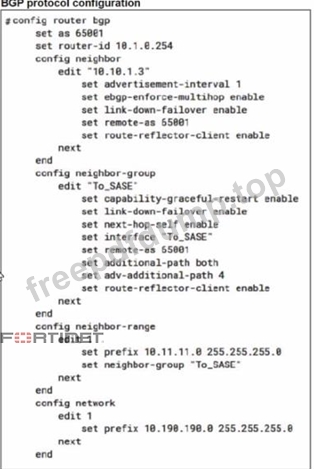
A FortiSASE administrator is trying to configure FortiSASE as a spoke to a FortiGate hub. The VPN tunnel does not establish Based on the provided configuration, what configuration needs to be modified to bring the tunnel up?
- A. The hub needs IKEv2 enabled in the IPsec phase 1 settings.
- B. The BGP router ID needs to match on the hub and FortiSASE.
- C. FortiSASE spoke devices do not support mode config.
- D. NAT needs to be enabled in the Spoke-to-Hub firewall policy.
Answer: A
NEW QUESTION # 24
Refer to the exhibit. A company has a requirement to inspect all the endpoint internet traffic on FortiSASE, and exclude Google Maps traffic from the FortiSASE VPN tunnel and redirect it to the endpoint physical Interface.
Which configuration must you apply to achieve this requirement?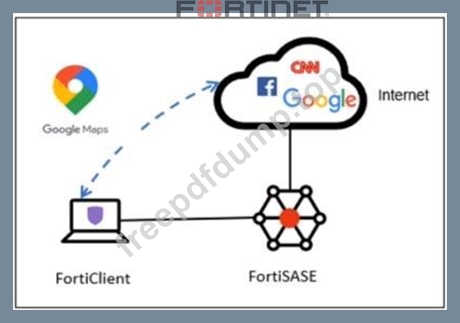
- A. Configure a static route with the Google Maps FQDN on the endpoint to redirect traffic
- B. Exempt the Google Maps FQDN from the endpoint system proxy settings.
- C. Change the default DNS server configuration on FortiSASE to use the endpoint system DNS.
- D. Configure the Google Maps FQDN as a split tunneling destination on the FortiSASE endpoint profile.
Answer: D
Explanation:
To meet the requirement of inspecting all endpoint internet traffic on FortiSASE while excluding Google Maps traffic from the FortiSASE VPN tunnel and redirecting it to the endpoint's physical interface, you should configure split tunneling. Split tunneling allows specific traffic to bypass the VPN tunnel and be routed directly through the endpoint's local interface.
Split Tunneling Configuration:
Split tunneling enables selective traffic to be routed outside the VPN tunnel. By configuring the Google Maps Fully Qualified Domain Name (FQDN) as a split tunneling destination, you ensure that traffic to Google Maps bypasses the VPN tunnel and uses the endpoint's local interface instead.
Implementation Steps:
Access the FortiSASE endpoint profile configuration.
Add the Google Maps FQDN to the split tunneling destinations list. This configuration directs traffic intended for Google Maps to bypass the VPN tunnel and be routed directly through the endpoint's physical network interface.
NEW QUESTION # 25
To complete their day-to-day operations, remote users require access to a TCP-based application that is hosted on a private web server. Which FortiSASE deployment use case provides the most efficient and secure method for meeting the remote users' requirements?
- A. zero trust network access (ZTNA) private access
- B. SD-WAN private access
- C. inline-CASB
- D. next generation firewall (NGFW)
Answer: A
Explanation:
Zero Trust Network Access (ZTNA) private access provides the most efficient and secure method for remote users to access a TCP-based application hosted on a private web server. ZTNA ensures that only authenticated and authorized users can access specific applications based on predefined policies, enhancing security and access control.
* Zero Trust Network Access (ZTNA):
* ZTNA operates on the principle of "never trust, always verify," continuously verifying user identity and device security posture before granting access.
* It provides secure and granular access to specific applications, ensuring that remote users can securely access the TCP-based application hosted on the private web server.
* Secure and Efficient Access:
* ZTNA private access allows remote users to connect directly to the application without needing a full VPN tunnel, reducing latency and improving performance.
* It ensures that only authorized users can access the application, providing robust security controls.
References:
FortiOS 7.2 Administration Guide: Provides detailed information on ZTNA and its deployment use cases.
FortiSASE 23.2 Documentation: Explains how ZTNA can be used to provide secure access to private applications for remote users.
NEW QUESTION # 26
How does ZTNA enhance security when accessing cloud applications?
Response:
- A. By limiting access based on user roles
- B. By encrypting end-to-end communications
- C. By providing a dedicated hardware path
- D. By ensuring physical security of data centers
Answer: A
NEW QUESTION # 27
How can FortiView be utilized to enhance security posture within an organization?
Response:
- A. By providing detailed insights into application usage
- B. By broadcasting system updates
- C. By displaying ads relevant to the IT department
- D. By tracking the physical locations of network devices
Answer: A
NEW QUESTION # 28
An organization needs to resolve internal hostnames using its internal rather than public DNS servers for remotely connected endpoints. Which two components must be configured on FortiSASE to achieve this?
(Choose two.)
- A. Split DNS rules
- B. SSL deep inspection
- C. DNS filter
- D. Split tunnelling destinations
Answer: A,B
Explanation:
To resolve internal hostnames using internal DNS servers for remotely connected endpoints, the following two components must be configured on FortiSASE:
* Split DNS Rules:
* Split DNS allows the configuration of specific DNS queries to be directed to internal DNS servers instead of public DNS servers.
* This ensures that internal hostnames are resolved using the organization's internal DNS infrastructure, maintaining privacy and accuracy for internal network resources.
* Split Tunneling Destinations:
* Split tunneling allows specific traffic (such as DNS queries for internal domains) to be routed through the VPN tunnel while other traffic is sent directly to the internet.
* By configuring split tunneling destinations, you can ensure that DNS queries for internal hostnames are directed through the VPN to the internal DNS servers.
References:
FortiOS 7.2 Administration Guide: Provides details on configuring split DNS and split tunneling for VPN clients.
FortiSASE 23.2 Documentation: Explains the implementation and configuration of split DNS and split tunneling for securely resolving internal hostnames.
NEW QUESTION # 29
Refer to the exhibits.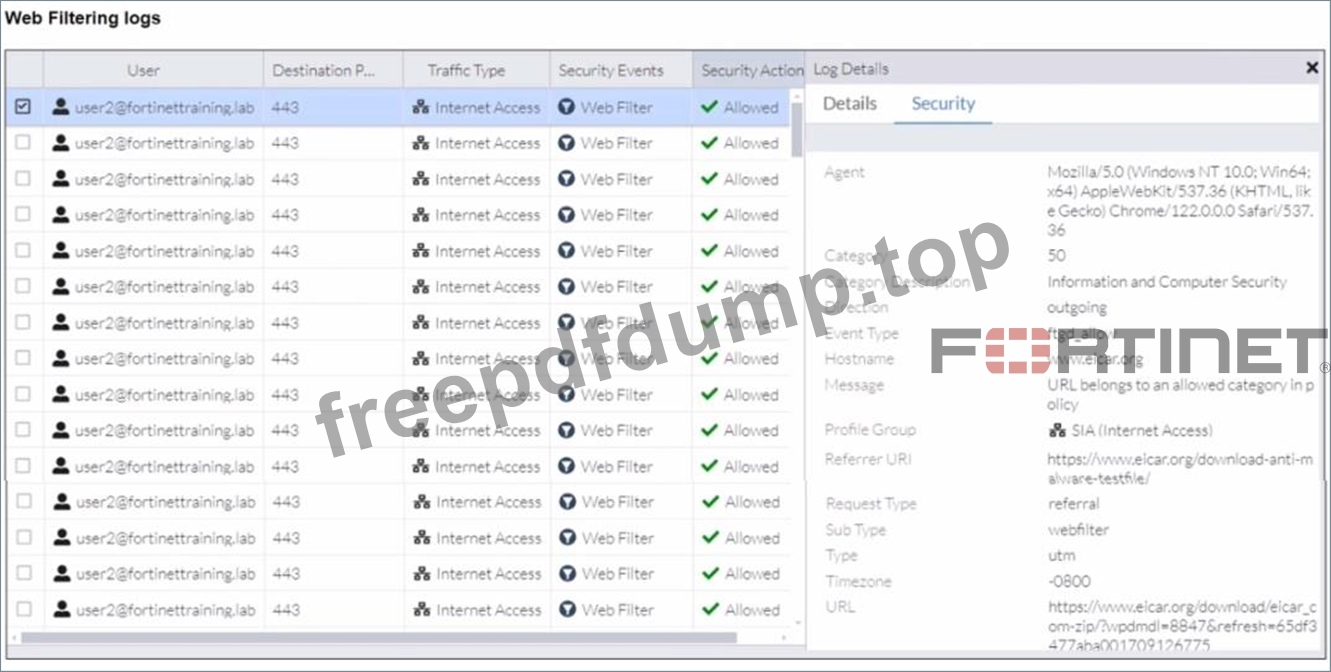
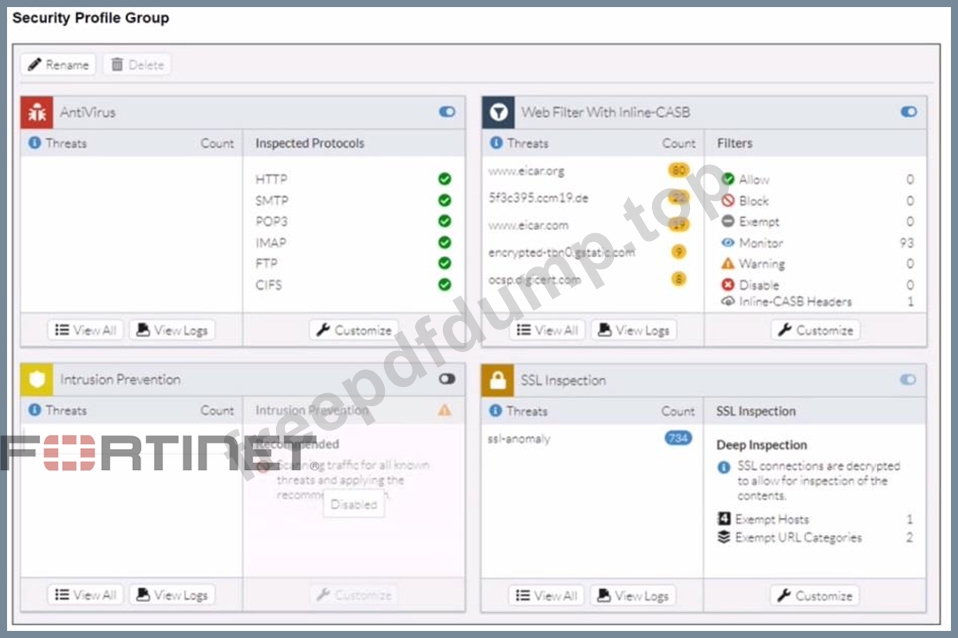
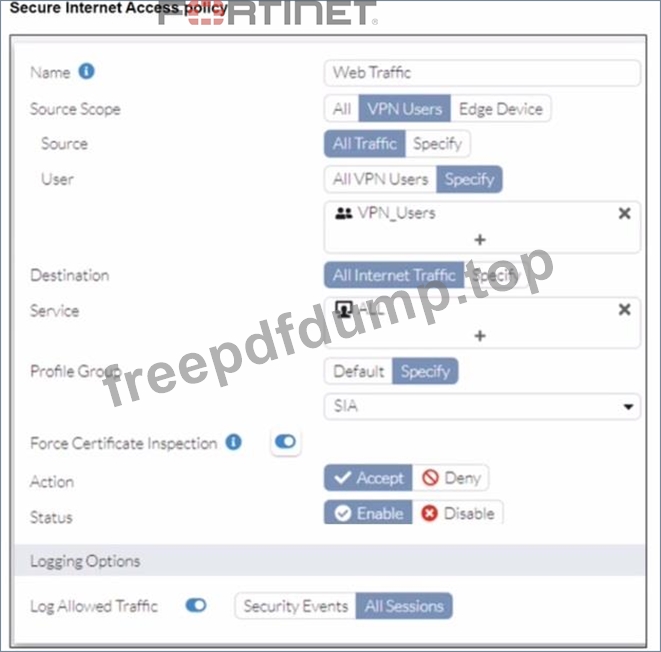
A FortiSASE administrator has configured an antivirus profile in the security profile group and applied it to the internet access policy. Remote users are still able to download the eicar.com-zip file from https://eicar.org. Traffic logs show traffic is allowed by the policy.
Which configuration on FortiSASE is allowing users to perform the download?
- A. Web filter is allowing the traffic.
- B. The HTTPS protocol is not enabled in the antivirus profile.
- C. Force certificate inspection is enabled in the policy.
- D. IPS is disabled in the security profile group.
Answer: C
Explanation:
https://community.fortinet.com/t5/FortiSASE/Technical-Tip-Force-Certificate-Inspection-option-in-FortiSASE/ta-p/302617
NEW QUESTION # 30
Which two components are part of onboarding a secure web gateway (SWG) endpoint? (Choose two)
- A. FortiClient installer
- B. FortiSASE CA certificate
- C. FortiSASE invitation code
- D. proxy auto-configuration (PAC) file
Answer: B,D
Explanation:
Onboarding a Secure Web Gateway (SWG) endpoint involves several components to ensure secure and effective integration with FortiSASE. Two key components are the FortiSASE CA certificate and the proxy auto-configuration (PAC) file.
FortiSASE CA Certificate:
The FortiSASE CA certificate is essential for establishing trust between the endpoint and the FortiSASE infrastructure.
It ensures that the endpoint can securely communicate with FortiSASE services and inspect SSL/TLS traffic.
Proxy Auto-Configuration (PAC) File:
The PAC file is used to configure the endpoint to direct web traffic through the FortiSASE proxy.
It provides instructions on how to route traffic, ensuring that all web requests are properly inspected and filtered by FortiSASE.
Reference:
FortiOS 7.2 Administration Guide: Details on onboarding endpoints and configuring SWG.
FortiSASE 23.2 Documentation: Explains the components required for integrating endpoints with FortiSASE and the process for deploying the CA certificate and PAC file.
NEW QUESTION # 31
When you configure FortiSASE Secure Private Access (SPA) with SD-WAN integration, you must establish a routing adjacency between FortiSASE and the FortiGate SD-WAN hub. Which routing protocol must you use?
- A. EIGRP
- B. IS-IS
- C. BGP
- D. OSPF
Answer: C
Explanation:
When configuring FortiSASE Secure Private Access (SPA) with SD-WAN integration, establishing a routing adjacency between FortiSASE and the FortiGate SD-WAN hub requires the use of the Border Gateway Protocol (BGP).
BGP (Border Gateway Protocol):
BGP is widely used for establishing routing adjacencies between different networks, particularly in SD-WAN environments.
It provides scalability and flexibility in managing dynamic routing between FortiSASE and the FortiGate SD-WAN hub.
Routing Adjacency:
BGP enables the exchange of routing information between FortiSASE and the FortiGate SD-WAN hub.
This ensures optimal routing paths and efficient traffic management across the hybrid network.
Reference:
FortiOS 7.2 Administration Guide: Provides information on configuring BGP for SD-WAN integration.
FortiSASE 23.2 Documentation: Details on setting up routing adjacencies using BGP for Secure Private Access with SD-WAN.
NEW QUESTION # 32
FortiSASE can only be deployed in cloud environments and does not support on-premises integration.
Response:
- A. False
- B. True
Answer: A
NEW QUESTION # 33
Refer to the exhibit. In the user connection monitor, the FortiSASE administrator notices the user name is showing random characters. Which configuration change must the administrator make to get proper user information?
- A. Change the deployment type from SWG to VPN.
- B. Turn off log anonymization on FortiSASE.
- C. Add more endpoint licenses on FortiSASE.
- D. Configure the username using FortiSASE naming convention.
Answer: B
Explanation:
In the user connection monitor, the random characters shown for the username indicate that log anonymization is enabled. Log anonymization is a feature that hides the actual user information in the logs for privacy and security reasons. To display proper user information, you need to disable log anonymization.
Log Anonymization:
When log anonymization is turned on, the actual usernames are replaced with random characters to protect user privacy.
This feature can be beneficial in certain environments but can cause issues when detailed user monitoring is required.
Disabling Log Anonymization:
Navigate to the FortiSASE settings.
Locate the log settings section.
Disable the log anonymization feature to ensure that actual usernames are displayed in the logs and user connection monitors.
NEW QUESTION # 34
Why is it important to configure both real-time and historical logging within FortiSASE for a comprehensive security overview?
Response:
- A. To use logs for marketing research
- B. To maintain an aesthetically pleasing dashboard
- C. To ensure all user actions are recorded for legal reasons
- D. To identify trends and patterns that could indicate evolving threats
Answer: D
NEW QUESTION # 35
......
Pass Fortinet FCSS_SASE_AD-24 exam Dumps 100 Pass Guarantee With Latest Demo: https://pass4sures.freepdfdump.top/FCSS_SASE_AD-24-valid-torrent.html
