

Jun-2026 Latest FreePdfDump NS0-185 Exam Dumps with PDF and Exam Engine Free Updated Today!
Following are some new NS0-185 Real Exam Questions!
NEW QUESTION # 65
Referring to the numbers shown in the exhibit, which port on an AFF A220 controller is used as porte0Min ONTAP?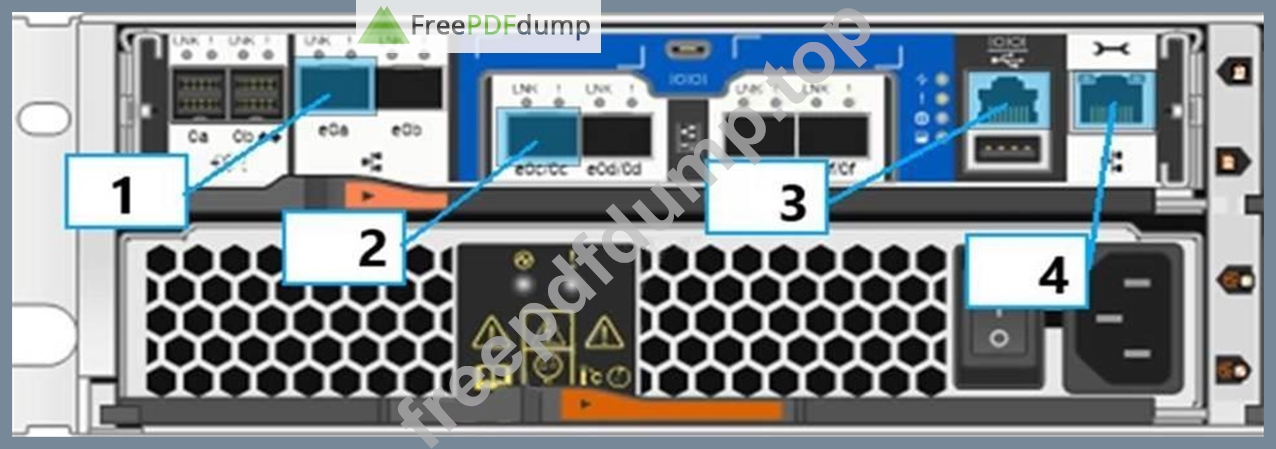
- A. 0
- B. 1
- C. 2
- D. 3
Answer: C
Explanation:
On AFF A220 systems, porte0Mis the dedicatedmanagement Ethernet portused for node management. This port is physically separate from data and cluster ports and is typically a 1GbE RJ-45 interface. In the exhibit, number1points to this dedicated management port.
ONTAP assigns the logical namee0Mautomatically to this physical interface, and it is reserved exclusively for management traffic. Administrators use e0M to configure node management LIFs, access the Service Processor (SP/BMC), and perform out-of-band management tasks.
Other numbered ports in the exhibit represent data, cluster, or console-related interfaces and cannot be used as e0M. Because ONTAP maps e0M to a fixed physical location on AFF A220 controllers, the correct answer is1
.
NEW QUESTION # 66
You have set up a new 2-node switchless cluster and want to verify that the failover is configured correctly.
In this scenario, which two commands accomplish this task? (Choose two.)
- A. storage failover show
- B. cluster ha show
- C. storage failover show-takeover
- D. cluster ring show
Answer: A,B
Explanation:
To verify failover in a two-node ONTAP configuration, you must confirm both cluster-level HA state (for two-node clusters) and storage failover state (takeover/giveback readiness) for the HA pair.
The commandcluster ha showis used to verify the cluster HA status, which is especially relevant in two-node clusters where cluster HA can affect whether services remain available when one node is halted/rebooted.
ONTAP documentation notes behaviors specific to two-node clusters and cluster HA, including the importance of proper HA configuration to avoid both nodes stopping data service under certain halt/reboot conditions.
The commandstorage failover showis the primary command to verify HA pair readiness, showing takeover
/giveback capability, partner connectivity, and status indicators needed to confirm that storage failover is configured correctly.
Option C (cluster ring show) is a cluster database/ring status diagnostic command; while it can be useful in troubleshooting quorum or RDB-related issues, it is not the standard command pair for verifying HA failover configuration correctness after installation. Option D (storage failover show-takeover) is not the common baseline verification command cited for confirming general failover configuration; it is more takeover-output oriented rather than providing the full readiness overview that storage failover show provides.
Therefore, the two commands that accomplish correct failover verification in this scenario areA. cluster ha showandB. storage failover show.
NEW QUESTION # 67
You want to use the NetAppDocs tool to collect information on a newly configured ONTAP 9.8 cluster and generate a Word document with cluster details.
Which two data sources would you use to collect the necessary data? (Choose two.)
- A. Active IQ Digital Advisor
- B. Active IQ Unified Manager
- C. AutoSupport packages
- D. ONTAP Cluster
Answer: C,D
NEW QUESTION # 68
What are three reasons to implement FabricPool? (Choose three.)
- A. to reclaim space on primary storage
- B. to move volumes to external capacity tiers
- C. to shrink secondary storage
- D. to implement storage efficiency features
- E. to use the volume backup feature
Answer: A,B,C
NEW QUESTION # 69
You are expanding an existing cluster that uses BES-53248 cluster interconnect switches. You connected the new controllers to ports 0/17 through 0/20. However, you are unable to join the new nodes to the cluster.
Which action must be taken to solve the problem?
- A. Reboot the controllers.
- B. Install the reference configuration file.
- C. Install the CSHM configuration file.
- D. Install the license file.
Answer: B
Explanation:
Broadcom BES-53248 cluster interconnect switches require aReference Configuration File (RCF)to define supported port roles, speeds, breakout behavior, ISLs, and node-facing ports. By default, only a subset of ports is enabled for cluster connectivity. Ports0/17 through 0/20are not active for node connections unless explicitly configured by the correct RCF.
When new controllers are cabled to ports that are not enabled or correctly configured for cluster interconnect traffic, the ONTAP nodes cannot establish cluster LIF communication and therefore cannot join the cluster.
Installing the correctRCFconfigures these ports with the required VLANs, MTU, flow control, and speed settings so that cluster traffic can pass.
A license file is not required for basic cluster interconnect functionality. The Cluster Switch Health Monitor (CSHM) configuration file enables monitoring, not port functionality. Rebooting controllers does not resolve switch-side configuration issues.
Therefore, installing thereference configuration fileis the required corrective action.
NEW QUESTION # 70
A customer has a 2-node FAS8200 cluster with four DS212C shelves with 10 TB SATA drives.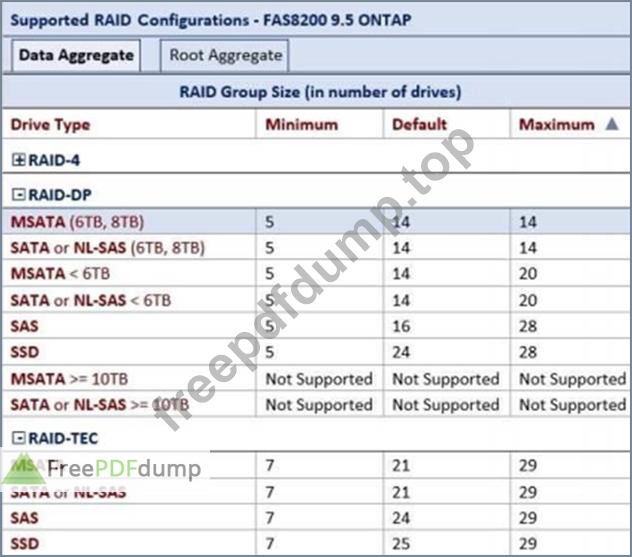
Referring to the exhibit, an aggregate will be created with which default RAID type?
- A. RAID-TEC
- B. RAID-DP
- C. RAID1
- D. RAID4
Answer: B
Explanation:
ONTAP 9.x defaults toRAID-DPfor SATA, NL-SAS, SAS, and SSD aggregates unless specific conditions require RAID-TEC. RAID-DP provides double-parity protection, allowing the system to withstand two simultaneous disk failures, which is essential for large-capacity SATA drives such as 10 TB disks.
RAID-TEC is reserved for very large aggregates with higher disk counts and is not the default. RAID4 and RAID1 are not used as default aggregate RAID types in ONTAP 9.
Therefore, the aggregate will be created withRAID-DP.
NEW QUESTION # 71
You want to add an AFF A400 system to an existing 4-node cluster.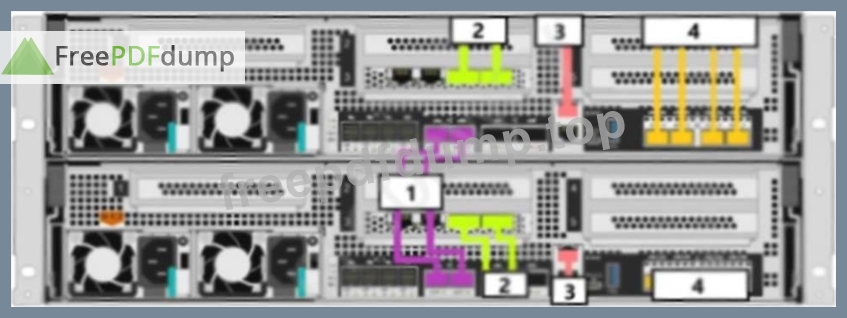
Referring to the exhibit, which number points to the ports that are used to cable the new nodes to the cluster interconnect switches?
- A. 0
- B. 1
- C. 2
- D. 3
Answer: D
Explanation:
When adding new nodes to an existing ONTAP cluster, proper cabling to the cluster interconnect switches is mandatory. The cluster interconnect network is a dedicated, private network used exclusively for internal cluster communication such as configuration synchronization, data movement, and quorum maintenance.
In AFF A400 systems, the cluster interconnect ports are fixed high-speed Ethernet ports that are clearly identified and reserved for cluster connectivity. These ports are typically 25GbE or 40GbE depending on configuration and are grouped together physically on the controller chassis.
Referring to the exhibit, the ports labeled with number 2 correspond to the cluster interconnect ports. These are the only ports that must be connected to the cluster interconnect switches when adding nodes to an existing cluster. ONTAP requires that each node have redundant connections to both cluster switches to maintain high availability and cluster quorum.
Ports labeled as other numbers in the exhibit represent different functions, such as management ports, data ports, or shelf connectivity ports, none of which are valid for cluster interconnect cabling.
NetApp installation procedures emphasize that incorrectly cabling non-cluster ports to cluster switches can prevent nodes from joining the cluster or cause cluster instability. Therefore, identifying and using the correct cluster interconnect ports is a critical installation step.
As shown in the exhibit, number 2 clearly identifies the correct ports used to cable the new AFF A400 nodes into the existing cluster interconnect infrastructure.
NEW QUESTION # 72
You are installing a new six-node ONTAP 9.8 cluster. You have completed the initial configuration of the cluster interconnect switches and the ONTAP cluster.
In this scenario, which feature should you enable?
- A. cluster switch logging
- B. IPv6 on all cluster ports
- C. data center bridging protocol
- D. cluster switch health monitor
Answer: D
Explanation:
After completing the initial configuration of a multi-node ONTAP cluster and its cluster interconnect switches, NetApp installation best practices require enabling proactive monitoring of the cluster network. The Cluster Switch Health Monitor (CSHM)is the ONTAP feature designed specifically for this purpose.
CSHM continuously monitors the health of supported cluster switches by collecting information such as switch configuration, port status, firmware versions, cabling, and error conditions. It validates this information against NetApp-supported configurations and best practices. When deviations or risks are detected, CSHM generates alerts and EMS messages that allow administrators to take corrective action before cluster communication is affected.
Cluster switch logging alone does not provide health analysis or proactive validation; it only records switch events. IPv6 is not required or recommended for cluster interconnect networks in standard ONTAP installations. Data Center Bridging (DCB) is used for specific Ethernet storage protocols and is not applicable to ONTAP cluster interconnect networks.
Therefore, enabling thecluster switch health monitoris the correct and required post-installation step.
NEW QUESTION # 73
After the installation of a new NetApp FAS system, you use the NetAppDocs tool for site design documentation.
In this scenario, in which three document formats would you create an inventory report? (Choose three.)
- A. .xlsx
- B. .ps
- C. .html
- D. .docx
- E. .pdf
Answer: A,D,E
Explanation:
Within the ONTAP SAN solution assessment domain, NetApp emphasizes the creation of accurate and reusable documentation immediately after system installation. One of the supported tools for this purpose is NetAppDocs, which is designed to collect system configuration data and generate standardized inventory and design documentation. According to NetApp Storage Installation concepts and objectives, inventory reports must be produced in formats that support both technical review and customer handoff, while remaining editable and auditable.
NetAppDocs is explicitly described in NetApp documentation as supporting Microsoft Word, Microsoft Excel, and PDF outputs for inventory-style reports. These formats align with operational best practices defined in installation and assessment workflows. Word (.docx) files are used to present structured design narratives and annotated configuration details. Excel (.xlsx) files are used to present tabular inventory data such as controllers, disk shelves, ports, adapters, WWPNs, and LIF assignments, which are critical for SAN assessment and future expansion planning. PDF (.pdf) files are used as finalized, non-editable deliverables suitable for compliance records, customer signoff, and archival purposes.
Formats such as HTML and PostScript (.ps) are not identified in NetApp Storage Installation objectives as supported NetAppDocs inventory outputs. These formats do not align with NetApp's standardized documentation deliverables and are not referenced in official installation or assessment documentation. As a result, they are excluded.
From a SAN-focused assessment perspective, the ability to generate Word, Excel, and PDF reports ensures consistency across deployment teams, simplifies validation of ONTAP SAN configurations, and supports accurate lifecycle documentation. These formats are repeatedly reinforced in NetApp installation guidance as the approved and supported inventory report outputs.
Therefore, the correct answers are A (.docx), C (.pdf), and E (.xlsx), as they are the only formats verified and supported for NetAppDocs inventory reporting within NetApp Storage Installation concepts and domains provided by NetApp.
NEW QUESTION # 74
On which type of network interfaces are the cluster interconnect LIFs created?
- A. on an interface group
- B. on an FC or FCoE port
- C. on a UTA port shared with other LIFs
- D. on a physical port
Answer: D
NEW QUESTION # 75
You were asked to install a FAS9000 with two quad-port SAS PCI cards installed in slot 9 and slot 1.
In this scenario, which ports are used for the second stack?
- A. 9c/1a
- B. 9b/1b
- C. 9a/1a
- D. 9a/1d
Answer: A
Explanation:
NetApp SAS cabling rules define port sequencing. The second stack uses9c and 1a, makingBcorrect.
NEW QUESTION # 76
Your customer wants a newly installed AFF C190 cluster to send SNMP notifications to a trap host called OVERWATCH01.
In this scenario, which two statements are correct? (Choose two.)
- A. Configure an SNMP community string on the cluster.
- B. Configure a trap host on the cluster.
- C. Configure DNS on the cluster.
- D. Configure a firewall policy and allow SNMP.
Answer: A,C
Explanation:
Within ONTAP SAN implementation and configuration, SNMP is commonly used to send event notifications to external monitoring systems. To successfully send SNMP traps to a named host such asOVERWATCH01, two foundational configuration requirements must be met.
First,an SNMP community string must be configuredon the cluster. The community string defines the authentication mechanism for SNMP communication and determines which monitoring systems are authorized to receive SNMP data. Without a configured community string, ONTAP will not generate or send SNMP notifications.
Second,DNS must be configured on the cluster. The trap destination is defined using a hostname rather than an IP address. ONTAP requires DNS name resolution to translate the hostnameOVERWATCH01into an IP address. Without DNS configuration, the cluster cannot resolve the trap host and therefore cannot deliver SNMP notifications.
While configuring a trap host is also required in practice, the question asks whichtwo statements are correct, not which actions complete the entire workflow. The critical dependencies that enable SNMP trap delivery to a named host are the SNMP community string and DNS resolution.
Firewall policies for SNMP are predefined and enabled by default in ONTAP for management traffic, so manual firewall configuration is not required during standard installation scenarios.
Therefore, the correct answers areA and B.
NEW QUESTION # 77
You installed a new 2-node FAS500f ONTAP 9.8 switchless cluster that serves NAS volumes to both NFSv4.
1 and SMB clients. The host operating systems have full flow control enabled on their data ports.
In this scenario, which two flow control settings would you verify? (Choose two.)
- A. Verify that the data network ports have full flow control disabled.
- B. Verify that the cluster network ports have full flow control enabled.
- C. Verify that the data network ports have full flow control enabled.
- D. Verify that the cluster network ports have full flow control disabled.
Answer: C,D
Explanation:
Flow control configuration is an important validation step in ONTAP SAN and NAS environments, especially in switchless cluster designs. NetApp documentation clearly differentiates flow control requirements between data networks and cluster networks.
For data network ports, full flow control must be enabled when hosts are configured with full flow control.
This ensures proper congestion management and prevents packet loss during high-throughput NAS operations such as NFSv4.1 and SMB traffic. Matching flow control settings between hosts and storage data ports is a best practice explicitly stated in NetApp installation guidance.
In contrast, cluster network ports must have flow control disabled. The cluster network is highly sensitive to latency and congestion, and enabling flow control on cluster interconnect ports can introduce delays that negatively affect cluster quorum, node communication, and overall stability. NetApp explicitly requires flow control to be disabled on cluster network interfaces.
Enabling flow control on cluster ports or disabling it on data ports would violate NetApp-supported configurations and can lead to performance degradation or cluster communication issues.
Therefore, the two correct settings to verify are:
Data network ports have full flow control enabled
Cluster network ports have full flow control disabled
This makes C and D the correct answers.
NEW QUESTION # 78
You were dispatched to install a cluster made up of FAS8060 and FAS8080 controllers. There are three FAS8060 controllers and three FAS8080 controllers.
Which solution would provide the largest possible cluster?
- A. a cluster made up of four nodes
- B. a cluster made up of six nodes
- C. a cluster made up of five nodes
- D. a cluster made up of two nodes
Answer: B
Explanation:
As part of the ONTAP SAN solution assessment domain, NetApp defines strict rules governingcluster composition and scalability. ONTAP clusters support a maximum of24 nodes, and within that limit, clusters can includedifferent controller models, provided they are supported by the same ONTAP release and meet hardware compatibility requirements.
BothFAS8060andFAS8080controllers are supported within ONTAP clusters and can coexist in a single cluster configuration. NetApp installation documentation explicitly allows mixed-controller clusters as long as the controllers are compatible and running the same ONTAP version.
In this scenario, there are six total controllers available: three FAS8060 and three FAS8080. Since ONTAP supports heterogeneous clusters and there is no architectural limitation preventing all six controllers from participating, thelargest possible clusteris achieved by includingall six nodes.
Smaller cluster sizes-two, four, or five nodes-are technically valid but do not meet the requirement of providing thelargest possible cluster. The assessment objective focuses on maximizing usable resources while staying within supported configuration guidelines.
Additionally, ONTAP automatically manages performance balancing and high availability across mixed- controller clusters. Each node pair forms an HA pair, and ONTAP ensures consistent data access across the entire cluster fabric.
Therefore, the correct answer isD, a cluster made up of six nodes.
NEW QUESTION # 79
You are asked to install a new cluster with six FAS8060 nodes. While running Config Advisor, you see the messages shown in the exhibit.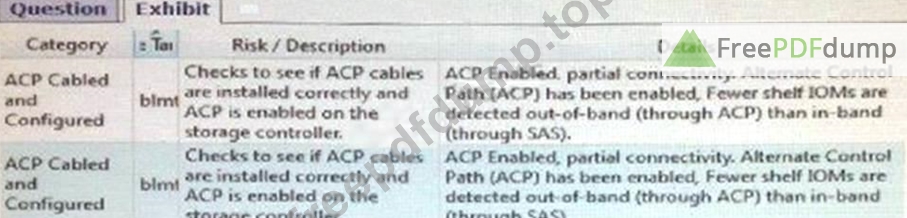
The customer does not want ACP cabled on their cluster.
Which two actions would allow the installation to be completed successfully? (Choose two.)
- A. Advise the customer that the error will cause the controller to not operate properly and create an unsupported state.
- B. Advise NGS that the customer has a controller in an unsupported state.
- C. Advise the sales team that the customer is operating without ACP and that the customer is asking you to leave it that way.
- D. Advise the customer that they must acknowledge that they are not using ACP on the installation.
Answer: C,D
Explanation:
Alternate Control Path (ACP) is a recommended butoptionalfeature in ONTAP installations. Config Advisor flags ACP-related warnings when ACP is partially cabled or not detected, but this does not automatically place the system in an unsupported state.
NetApp installation policy requires that when customers choose not to deploy ACP, the decision must be explicitly acknowledged and documented. This ensures the customer understands the operational implications and accepts responsibility for reduced out-of-band shelf management visibility.
Additionally, installation best practices require that this decision becommunicated to the sales team or account team. This ensures alignment across NetApp stakeholders and prevents future support disputes.
The system does not become unsupported solely because ACP is not used, provided the customer acknowledgment process is followed. Therefore, options implying an unsupported or nonfunctional state are incorrect.
The correct answers areB and C.
NEW QUESTION # 80
You have a 4-node FAS8060 cluster. You use the vol move command to relocate a volume from an aggregate on node 1 to an aggregate on node 4.
In this scenario, which network is used for the traffic being relocated?
- A. the node management network
- B. the intercluster network
- C. the cluster interconnect
- D. the HA interconnect
Answer: C
NEW QUESTION # 81
Which set of components on a FAS9000 are highlighted in the exhibit?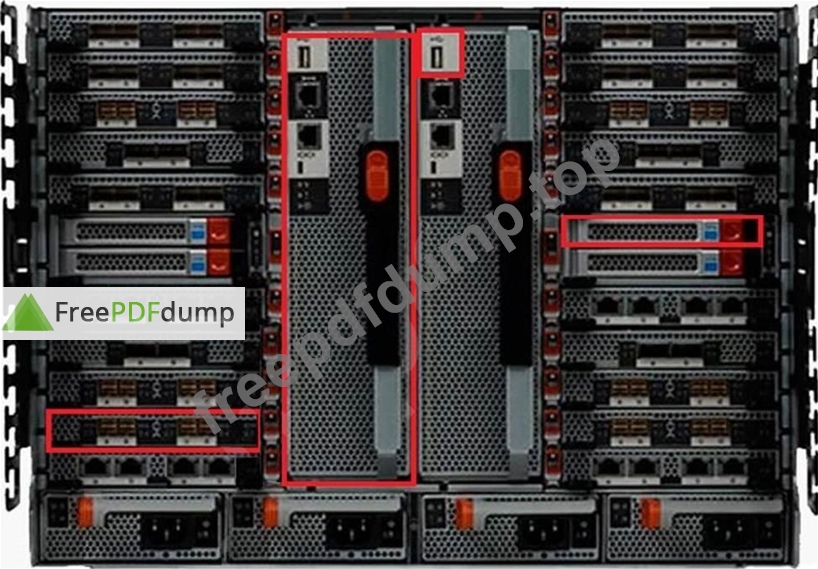
- A. NVRAM-Module, Controller, Serial-Port, FlashCache-Module
- B. FCVI-Module, Controller, Serial-Port, FlashCache-Module
- C. SAS-Module, Controller, USB-Port, FlashCache-Module
- D. Powersupply, Controller, USB-Port, NVRAM-Module
Answer: A
Explanation:
Understanding hardware components is a core requirement within ONTAP SAN concepts. The exhibit highlights several key components on a FAS9000 system that are essential to system operation and high availability.
The large central components shown are the controllers, which house the CPUs, memory, and network interfaces responsible for data processing and cluster operations. Adjacent to the controllers are the NVRAM modules, which are critical for write caching and data integrity. NVRAM ensures that incoming write operations are safely logged and protected in the event of power loss or controller failover.
The exhibit also highlights the serial ports, which are used for low-level system access during installation, troubleshooting, or recovery scenarios. Serial ports are especially important during initial setup or when network access is unavailable.
Finally, the highlighted FlashCache modules provide read caching functionality. FlashCache accelerates read- intensive workloads by caching frequently accessed data on flash memory, improving overall system performance.
Other options are incorrect because they either include components not highlighted in the exhibit (such as power supplies or USB ports) or misidentify the flash modules. Therefore, the correct set of components shown in the exhibit is NVRAM-Module, Controller, Serial-Port, FlashCache-Module.
NEW QUESTION # 82
......
Resources From:
- 2026 Latest FreePdfDump NS0-185 Exam Dumps (PDF & Exam Engine) Free Share: https://pass4sures.freepdfdump.top/NS0-185-valid-torrent.html
Free Resources from FreePdfDump, We Devoted to Helping You 100% Pass All Exams!
