

[Mar-2026] PECB ISO-14001-Lead-Auditor Dumps - Secret To Pass in First Attempt
PECB ISO-14001-Lead-Auditor Exam Dumps [2026] Practice Valid Exam Dumps Question
NEW QUESTION # 12
An audit team leader arrives at a steel fabrication organisation that manufactures fire escape stairs to carry out a Stage 2 certification audit. At a meeting with the EMS Manager, she is told that they have won their biggest contract from a construction organisation to manufacture and install fire escape stairs. They appointed a subcontractor to perform the installation work. The EMS Manager wants the ISO 14001 audit extended to cover the installation site.
Select which one of the options is the correct response by the auditor.
- A. Would you write to my audit programme manager with this request?
- B. We have used all our allocated time in preparation for this audit so how can we extend the audit scope?
- C. Can you arrange to bring the installation team here so that we can include this in the audit?
- D. Do you realise that this involves an extension to the scope of the audit and will require an application process?
Answer: D
Explanation:
According to ISO/IEC 17021-1:2015 Clause 9.3.1 and ISO 19011:2018 Clause 5.4.1:
Any change in scope requires formal review and approval through certification body's application process.
The auditor cannot unilaterally extend the scope during the audit.
The correct course of action is to inform the auditee that scope changes require an application process.
Reference: ISO/IEC 17021-1:2015 Clause 9.3.1; ISO 19011:2018 Clause 5.4.1.
NEW QUESTION # 13
Showitoff is an organisation specialising in the design and production of wall decorating materials for the domestic market. During an ISO 14001 certification audit of the site, the auditor comes across an open, walled area just outside the maintenance department. It contains various scraps of wood and metal as well as several rusty components. They are lying on an oily floor. When asked about it, the EMS Manager states that he presumes that the materials come from maintenance work.
The auditor interviews the Maintenance Manager in his department. He notes that shelves containing various spares are well labelled and neatly stacked. He asked about the "dump" outside and is told that it contains some excess materials that the Manager likes to keep in case they come in handy at some stage. The auditor points out that the "dump" might be classed under regulations as a landfill site, which requires an operating licence. The Maintenance Manager is not aware of such a licence.
Which three statements represent good audit practice?
- A. The auditor should advise the organisation to get rid of all the "dumps".
- B. The auditor should ask the Maintenance Manager to clean up the "dump".
- C. The auditor should check whether the organisation has permission to operate a landfill site.
- D. The auditor should congratulate the Maintenance Manager on having a neat and tidy spares store.
- E. The auditor should raise a nonconformity against ISO 14001.
- F. The auditor should refer the organisation to the relevant authorities.
- G. The auditor should check the information given by the Maintenance Manager with the EMS Manager.
- H. The auditor should consider surveying more areas of the site for other "dumps".
Answer: C,G,H
NEW QUESTION # 14
During a Stage 1 audit, the EMS Manager asks that the audit includes coverage of a new storage site on the other side of town that they have taken over since the application was made.
Which two of the following actions should the auditor take?
- A. Inform the auditee that the Stage 2 will be changed to include the new site.
- B. Determine whether the EMS Management System covers the new site and, if so, proceed with the audit.
- C. Advise the EMS Manager that, within the existing scope, the new site can be included without any problem.
- D. Advise the EMS Manager that the audit scope has been set and the audit will need to proceed as planned.
- E. Suggest that the EMS Manager cancels the audit contract and reapplies for the new situation.
- F. Advise the EMS Manager that an extension of the scope is possible but will have to go through established procedures.
Answer: B,F
Explanation:
According to ISO/IEC 17021-1:2015 Clause 9.2.2 and 9.3.1:
Scope changes may be accommodated during the certification process, but proper evaluation is required.
The auditor should:
Confirm whether the EMS has been extended to cover the new site (C).
Inform that scope expansion needs to follow formal procedures through the certification body (F).
Simply including the new site without evaluation (A) is incorrect.
The audit plan can be adjusted, but full reassessment (D) is unnecessary unless significant issues arise.
Reference: ISO/IEC 17021-1:2015 Clause 9.2.2, 9.3.1; ISO 14001 Lead Auditor Course Guide.
NEW QUESTION # 15
In the case of ISO 14001 EMS audits that follow the recommendations of ISO 19011, which two of the following statements are true?
- A. Internal auditors can audit their own work.
- B. Second-party audits are conducted by certification body auditors with experience in evaluating legal compliance.
- C. EMS auditors do not need to evaluate the organisation's capability to respond to and recover from disruptive incidents.
- D. The frequency of internal audits is determined based on the environmental importance of the processes concerned.
- E. The audit plan should consider the effect of the audit activities on the auditee's processes.
- F. An audit on an external provider may also be referred to as a third-party audit.
Answer: D,E
Explanation:
From ISO 19011:2018:
Clause 5.4.3:
"The audit plan should consider the potential impact on the auditee's processes during audit activities to minimize disruption." Clause 5.2 and 5.3:
"The audit programme frequency should be based on the significance of the environmental aspects, past audit results, changes, and risks." Internal auditors auditing their own work violates auditor impartiality (Clause 4.4.2 - Auditor Independence).
Second-party audits are customer-supplier audits, not certification body audits (Clause 3.7 - Audit Types).
EMS auditors must consider the organization's preparedness for emergencies (ISO 14001:2015 Clause 8.2).
Reference: ISO 19011:2018 Clauses 4.4.2, 5.2, 5.3, 5.4.3; ISO 14001:2015 Clause 8.2.
NEW QUESTION # 16
Considering the requirements of clauses 6.1.2 and 6.1.4 of ISO 14001:2015, put the actions in the correct order to complete a process/task.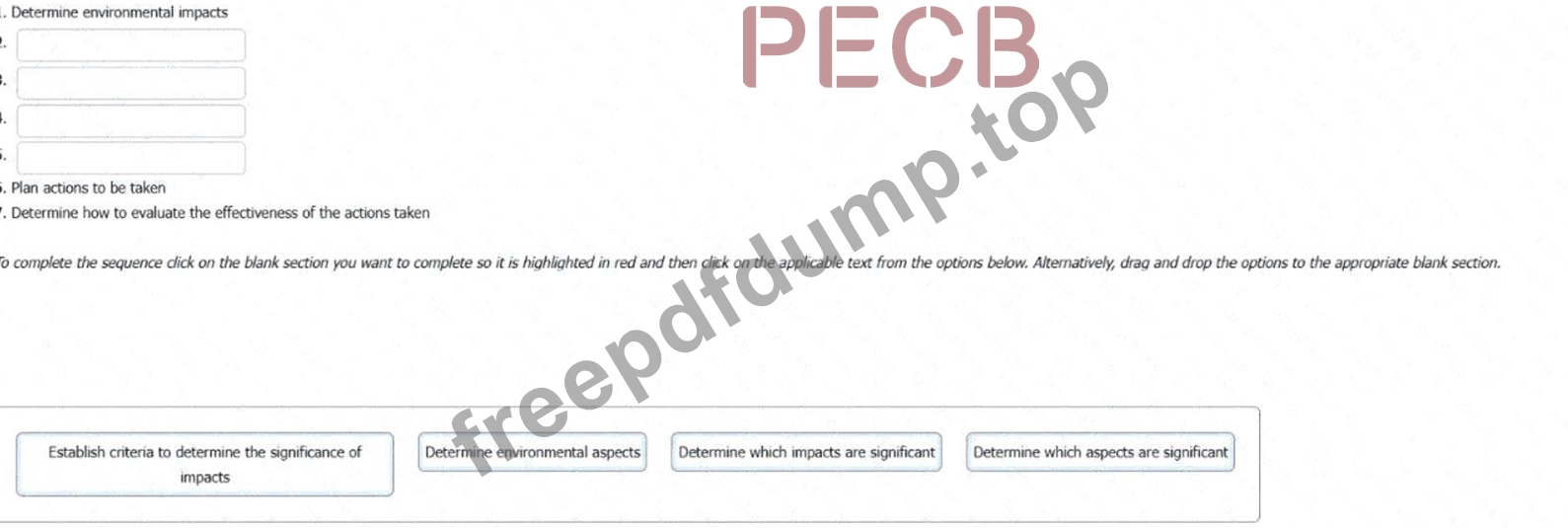
Answer:
Explanation: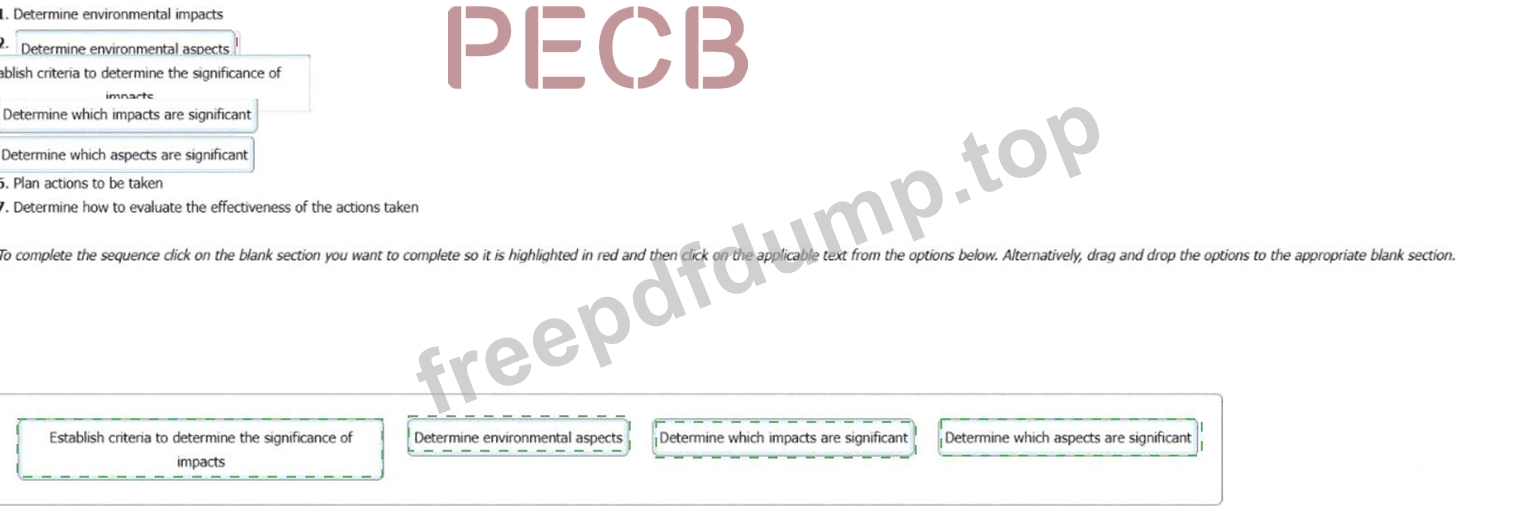
Explanation: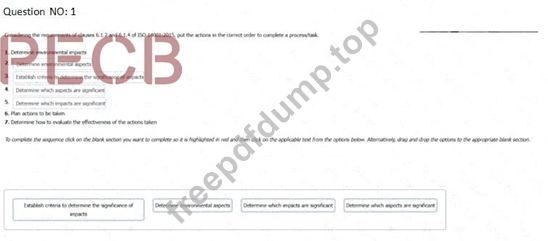
Determine environmental aspects
Determine environmental impacts
Establish criteria to determine the significance of impacts
Determine which impacts are significant
Determine which aspects are significant
Plan actions to be taken
Determine how to evaluate the effectiveness of the actions taken
According to ISO 14001:2015 clause 6.1.2 (Environmental Aspects), an organization must determine the environmental aspects of its activities, products, and services that it can control and influence, and their associated environmental impacts.
Once identified, the organization shall:
Determine the aspects that can have significant impact on the environment using established criteria for evaluating significance. (Reference: ISO 14001:2015, clause 6.1.2) Then, as per clause 6.1.4 (Planning action), the organization needs to:
Plan actions to address significant environmental aspects, legal requirements, and risks/opportunities.
Determine how to evaluate the effectiveness of these actions to ensure continual improvement.
This logical sequence ensures a structured and risk-based approach to identifying and managing environmental impacts.
Reference: ISO 14001:2015 - Clause 6.1.2 and 6.1.4
NEW QUESTION # 17
What are the primary purposes of implementing an EMS based on ISO 14001:2015? Select two.
- A. It is used to demonstrate to external parties that the organisation has met all its legal requirements.
- B. It provides a framework for protecting the environment.
- C. It provides a means by which environmental impacts are addressed at relevant stages of the life cycle.
- D. It improves the organisation's financial results.
- E. It ensures that organisations operate fully online management systems.
- F. It enables the organisation to tender for government-funded contracts.
Answer: B,C
Explanation:
According to ISO 14001:2015 Clause 1 (Scope) and Clause 6.1.2:
Clause 1:
"The purpose of this International Standard is to provide organizations with a framework to protect the environment and respond to changing environmental conditions in balance with socio-economic needs." Clause 6.1.2:
"The organization shall determine the environmental aspects of its activities, products and services that it can control and influence, considering a life cycle perspective." Demonstrating legal compliance (B) is part of the intended outcomes but not the primary purpose.
Tender eligibility (C), financial results (E), and system format (F) are not stated objectives of ISO 14001:2015.
Reference: ISO 14001:2015 Clauses 1, 6.1.2.
NEW QUESTION # 18
Whistlekleen is a national dry cleaning and laundry organisation with 50 shops. You are conducting an EMS surveillance audit of Head Office and are sampling environmental performance measurement. You find that
80 per cent of failures to meet performance criteria originate from five shops in the same region. Most of these failures relate to the release of volatile organic compounds (VOCs) that exceeded regulations. The Environmental Manager tells you that these are the oldest shops in the organisation. The cleaning equipment needs replacing but the organisation cannot afford it at the moment.
On raising the matter with senior management, you are told that there are plans to replace the equipment in these shops over the next five years.
When reviewing the nonconformity report files, you find that the organisation is facing a legal dispute with the environmental authority over multiple breaches of environmental legislation.
Select the three best options for how this dispute should be handled by the organisation through its EMS.
- A. Advise the authority that timely corrective action will be taken.
- B. Investigate changing the cleaning process to use chemicals with lower VOC content.
- C. Conduct an internal enquiry to establish who is to blame.
- D. Monitor VOC emissions to ensure compliance with legal requirements.
- E. Offer to compensate employees for possible health implications.
- F. Give an explanation to the authority of what went wrong.
- G. Advise the authority that the faulty equipment will be maintained more often.
- H. Ask to settle the court case by negotiation with the authority.
Answer: A,B,D
NEW QUESTION # 19
An organisation has ISO 14001 EMS certification from a third-party certification body. Which one of the following represents an advantage of having accredited certification?
- A. An increase in the number of clients.
- B. Recognition of the credibility of the certification process.
- C. Clarity of the audit report.
- D. An increase in the marketing price of the organisation's products.
Answer: B
Explanation:
Accredited certification under ISO 14001 refers to certification that has been issued by a certification body that is itself accredited by a national accreditation body. This provides formal recognition that the certification body is competent to perform audits and issue certifications in accordance with ISO/IEC 17021 standards.
According to guidance in ISO 14001 Lead Auditor training materials and ISO/IEC 17021, one of the key benefits of accredited certification is:
"Recognition of the credibility, impartiality, and technical competence of the certification process and the certification body issuing the certificate." This recognition:
Increases stakeholder confidence (e.g., regulators, clients, the public), Supports market access and tender qualifications, Confirms that audits are performed in accordance with international best practices.
Option D correctly reflects the most strategic and system-level benefit of accredited certification.
The other options (A, B, and C) may result indirectly or are not directly linked to the purpose of accreditation.
Reference:
ISO/IEC 17021:2015 - Requirements for bodies providing audit and certification of management systems ISO 14001 Lead Auditor Course Guide - Module on Certification and Accreditation ISO 14001:2015 - Clause 3.1.1 & 3.1.2 (definition of EMS and system credibility)
NEW QUESTION # 20
Which two of the following options are an advantage of using a sampling plan for the audit?
- A. Reduces the audit duration
- B. Gives confidence in the audit results
- C. Use of the plan for consecutive audits
- D. Overrules the auditor's instincts
- E. Implements the audit plan efficiently
- F. Prevents conflict within the audit team
Answer: A,B
Explanation:
According to ISO 19011:2018 Clause 5.3.2 and Annex B (Audit Sampling):
Sampling allows auditors to:
Reduce audit time while still covering sufficient evidence (A),
Provide statistically valid assurance and confidence in the results (C).
Sampling does not replace auditor judgment (D), nor is it intended to prevent conflict (F) or be reused blindly for future audits (E).
Reference: ISO 19011:2018 Clause 5.3.2, Annex B.
NEW QUESTION # 21
You are auditing the ISO 14001 management system of a primary school (School 21st Century) located in downtown Lima, Peru. There are 400 students, attending classes from 9 am until 5.30 pm.
You have presented a nonconformity at the closing meeting:
Non-conformity - No environmental aspect has been identified related to the impact of the education provided by the school on students' awareness (as future adults) related to generic environmental issues.
Select the three best acceptable corrections that the school may take.
- A. Establish environmental objectives for the school
- B. Revise the school's environmental policy to include environmental concerns
- C. Hire an environment expert next week to deliver a lecture on the environment to all students
- D. Add the education on generic environmental issues to the list of environmental aspects of the school's EMS
- E. Ask the National Environmental Agency for reading materials to give to students before the lecture by the expert
- F. Review the procedure for waste management in the school
- G. Hire an environmentalist next month to deliver a couple of lectures on the environment to all employees of the school, except students
- H. Thoroughly review the syllabus for next year to include environmental issues whenever appropriate
Answer: C,D,H
NEW QUESTION # 22
An oil organisation has a natural gas treatment plant on land crossed by several small rivers. On one particular day, after heavy rainfall for 48 hours, some of those rivers burst their banks and flooded the water treatment facilities of the plant. The oil-contaminated water reached some scarcely populated areas nearby.
Soon after, an internal audit was carried out to particularly analyse this event that was considered a nonconformity. There were no records of such heavy rainfall in the past 200 years.
Which three of the following actions are 'corrections'?
- A. Offer loans to the persons affected to build new houses far from the plant
- B. Revise the existing emergency plan
- C. Send the contaminated land for processing
- D. Reinforce the riverbanks with cement
- E. Build up some additional protection to the water treatment plant
- F. Relocate the water treatment plant to lower ground
- G. Clean up the houses of the persons affected
- H. Clean up the affected land
Answer: C,G,H
NEW QUESTION # 23
Which two audit characteristics are features of a Stage 1 initial certification audit?
- A. Reviewing some of the auditee's documentation.
- B. The purpose of this audit is to determine if the EMS is effectively implemented and maintained.
- C. The audit team's recommendation regarding certification is the key outcome of this stage.
- D. To conduct an analysis of the organisation's environmental system processes to determine compliance obligations.
- E. Gaps in the EMS against the requirements of ISO 14001 are reported as 'areas of concern'.
- F. Except for a pandemic or other natural disaster, this audit must be performed onsite at the auditee's location.
Answer: A,E
Explanation:
According to ISO/IEC 17021-1:2015 Clause 9.3.2.1:
Stage 1 includes:
Reviewing management system documentation (E).
Identifying areas of concern that could become nonconformities at Stage 2 (C).
Evaluating readiness for Stage 2, but not making certification decisions (D).
Stage 1 focuses on preparedness; Stage 2 evaluates full implementation (F).
Onsite requirement (B) is generally true but flexibility is permitted per IAF MD rules.
Reference: ISO/IEC 17021-1:2015 Clause 9.3.2.1; ISO 14001 Lead Auditor Course Guide.
NEW QUESTION # 24
Sparkle is an organisation that provides mobile car cleaning services at customers' premises. It has been certified to ISO 14001 for some time and has appointed a full-time Environmental Management System Manager. The audit plan during a surveillance audit includes continual improvement and the auditor asks to see the most recent management review meeting minutes.
The minutes indicate that the Environmental Management System Manager reported that the last review of the organisation's environmental legislation register was made three years ago instead of annually as planned in the Environmental Management System. At that time, he asked for finances to employ a legislation expert to update the register but was denied the request by top management on the basis that it was unlikely that many changes to legislation had occurred. No related improvement actions were documented in the minutes.
Based on the scenario, select the two options which best describe the evidence for raising such a non- conformity.
- A. The organisation failed to update its legislation register following the planned frequency of review.
- B. Raise an opportunity for improvement (OI) to reduce damaging emissions.
- C. Evaluate whether the process for measuring environmental performance is effective.
- D. Extend the audit plan to include the five shops.
- E. Recommend that staff in the five shops should have medical check-ups due to air pollution.
- F. Determine if the local authority has been informed that the organisation is exceeding VOC emissions.
Answer: A,B
NEW QUESTION # 25
You are conducting a Stage 2 certification audit of VitalSpark, a pharmaceutical organisation manufacturing vitamins and other healthcare medicines. In a separate area in the centre of their large site, a supplier produces oxygen supplies piped directly into the manufacturing processes of VitalSpark. They also deliver oxygen in bulk tankers to other customers. When you review the environmental aspects register, you find that the only environmental aspect recorded for this arrangement relates to the heavy goods vehicles of the supplier transiting the site.
You ask the EMS Manager about the environmental consequences to VitalSpark of this arrangement and are told that they are not significant since the supplier has its own services for water, sewage, waste and energy.
The EMS Manager tried unsuccessfully to communicate with the supplier who is located inside the VitalSpark site and outside the scope of the EMS.
You raise a non-conformance against clause 6.1.2 of ISO 14001:
"VitalSpark does not maintain documented information on aspects/impacts related to activities, products and services of the oxygen supplier." Which combination of two of the following actions proposed by VitalSpark would permit you to close out the nonconformity?
- A. The oxygen supplier will be requested to implement an ISO 14001 management system within the next
3 months. - B. The oxygen supplier will be requested to undertake a full environmental survey of its processes.
- C. VitalSpark will expand its audit programme to include audits of the oxygen supplier's organisation.
- D. VitalSpark will suggest that the oxygen supplier should undertake training in environmental awareness.
- E. VitalSpark will update its documented information on aspects/impacts to include those related to the oxygen supplier.
- F. VitalSpark will retrieve environmental data on a monthly basis from the on-site supplier.
Answer: E,F
NEW QUESTION # 26
Which one of the following outcomes of an audit does not require the auditee to respond?
- A. A non-conformity.
- B. A conformity.
- C. An opportunity for improvement.
- D. A diverging opinion concerning the audit evidence.
Answer: B
Explanation:
According to ISO 19011:2018 Clause 3.11 (Audit findings) and Clause 6.4.10:
Audit findings can be conformity, nonconformity, or opportunity for improvement.
A conformity simply confirms that the requirements have been met no further action is required from the auditee.
Nonconformities require corrective actions.
Opportunities for improvement may trigger voluntary action but not mandatory response.
Diverging opinions are handled during the audit but don't require post-audit response unless linked to nonconformity.
Reference: ISO 19011:2018 Clause 3.11, 6.4.10; ISO 14001 Lead Auditor Guide - Audit Findings.
NEW QUESTION # 27
A key audit process is the way auditors gather information and determine the findings' characteristics. Put the actions in the correct order to complete this process.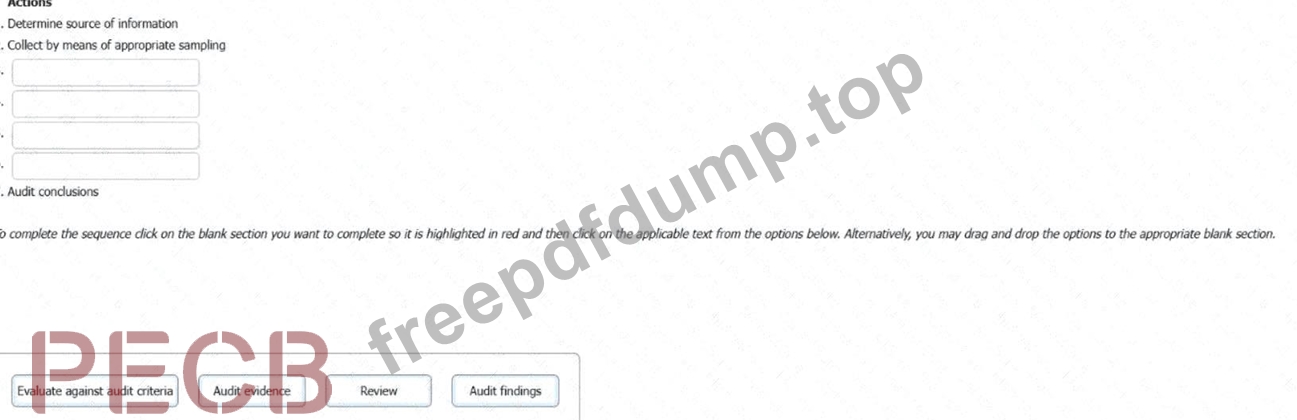
Answer:
Explanation: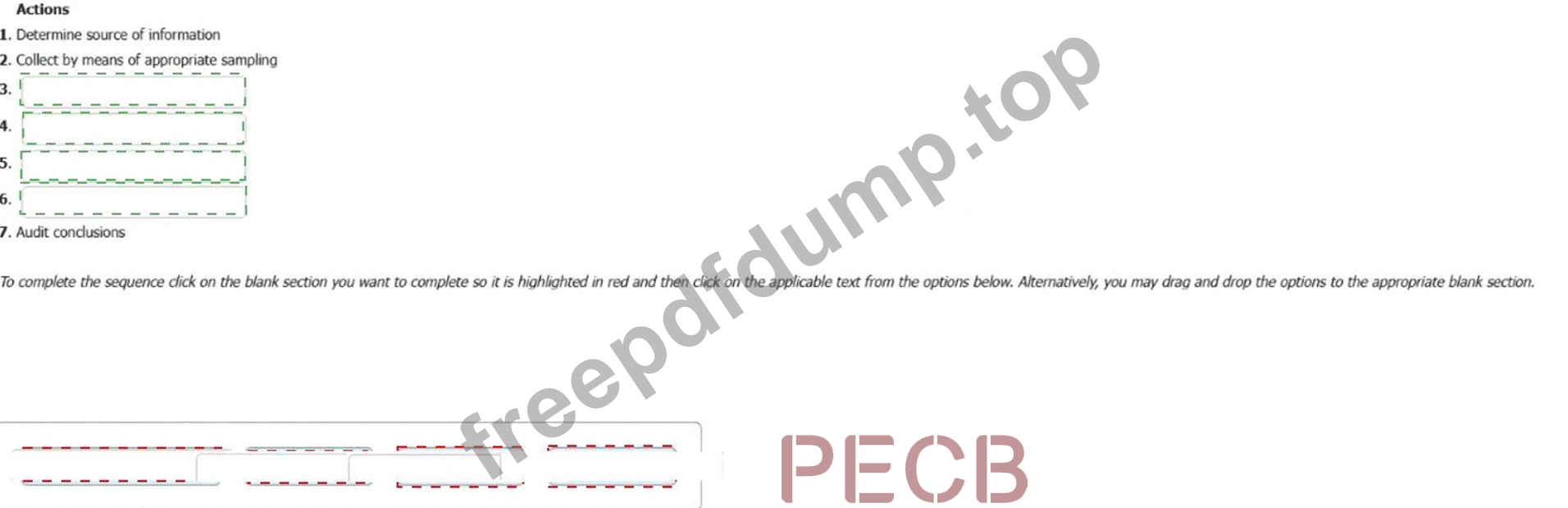
Explanation:
A screenshot of a computer AI-generated content may be incorrect.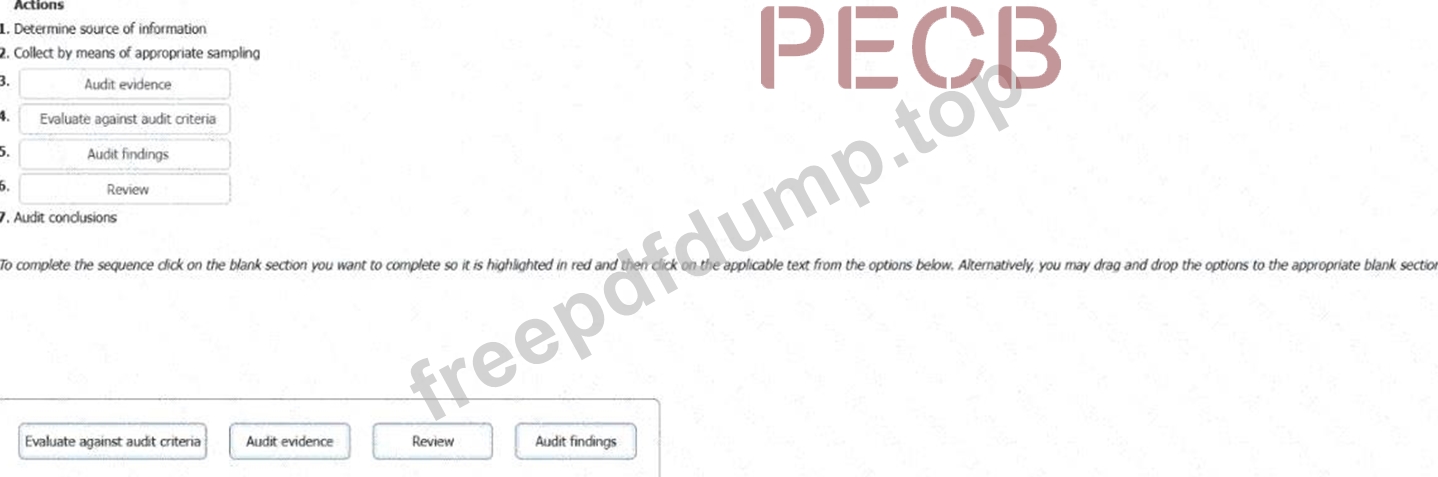
This sequence is derived from ISO 19011:2018 - Guidelines for Auditing Management Systems, which is used in conjunction with ISO 14001:2015 by auditors. Specifically, the audit process steps during the
"conducting the audit" phase include:
Determining the source of information (Clause 6.4.5): Includes documents, interviews, records, and observations.
Collecting data by sampling (Clause 6.4.6): Sampling helps in managing resources and gathering relevant evidence effectively.
Gathering audit evidence (Clause 3.8): Audit evidence is the data collected and verified to support findings.
Evaluating against audit criteria (Clause 3.9): Evidence must be evaluated against standards such as ISO
14001 requirements, internal policies, etc.
Developing audit findings (Clause 6.4.9): Conclusions regarding conformance, nonconformance, and opportunities for improvement.
Review of findings (Clause 6.4.10): Cross-verification and validation before finalizing results.
Audit conclusions (Clause 6.4.11): Final statements summarizing the audit based on findings.
This structured process ensures audits are performed impartially, with verifiable, evidence-based outcomes that contribute to continual improvement.
Reference:
ISO 19011:2018, Clauses 6.4.5 to 6.4.11
ISO 14001:2015, Clause 9.2 - Internal audit requirements
NEW QUESTION # 28
......
ISO-14001-Lead-Auditor Exam Dumps PDF Guaranteed Success with Accurate & Updated Questions: https://pass4sures.freepdfdump.top/ISO-14001-Lead-Auditor-valid-torrent.html
