

ISQI Exam 2026 CTFL-AcT Dumps Updated Questions UPDATED Mar-2026
Get The Most Updated CTFL-AcT Dumps To ISTQB Foundation Level Certification
The CTFL-AcT exam is designed for testers, test analysts, and test engineers who are involved in acceptance testing activities. It is also suitable for professionals who want to enhance their understanding of acceptance testing and improve their testing skills. CTFL-AcT exam consists of 40 multiple-choice questions, and the duration is 60 minutes. To pass the exam, candidates must achieve a minimum score of 65%. The CTFL-AcT certification is valid for life, and it demonstrates the candidate's expertise in acceptance testing, which is highly valued in the software development industry.
NEW QUESTION # 33
Which one of the following statements describes correctly how acceptance testing may be augmented with other test techniques or approaches?
- A. In a black-box testing approach, acceptance test scenarios follow the implemented sequence of function calls in the code.
- B. In a model-based testing approach, acceptance tests are generated from graphical or textual models.
- C. In a priority-based testing approach, prioritization of acceptance tests depends on identified product risks.
- D. In a risk-based testing approach, acceptance criteria are derived from the tester's experience and intuition.
Answer: B
NEW QUESTION # 34
Which tool fits the mentioned acceptance test activities BEST?
- A. Business process management tools for modeling business processes and rules.
- B. Model-based testing tools for managing incidents.
- C. Requirements management tools for managing acceptance test execution campaigns.
- D. Test management and automation tools for business process model-based acceptance test generation.
Answer: A
Explanation:
Acceptance testing often relies on understanding and validating business processes and business rules. These are typically visualized and documented using business process modeling techniques such as BPMN (Business Process Model and Notation) and decision tables (DMN - Decision Model and Notation).
Business Process Management (BPM) tools are specifically designed for modeling and managing such workflows and rules. These tools are commonly used during acceptance test design to align tests with business objectives and processes.
Option C is correct because it directly aligns with the use of business process modeling in acceptance testing activities.
Other options:
A is incorrect because requirements management tools are more focused on requirement traceability and prioritization, not managing test execution campaigns.
B confuses roles - test management/automation tools can assist with test generation, but "business process model-based" generation is more accurately linked to BPM or model-based testing tools.
D is incorrect - model-based testing tools are used for test case generation, not incident management.
C). Business process management tools for modeling business processes and rules.
NEW QUESTION # 35
Which one of the following usability testing techniques matches the test objective BEST?
- A. Biometrics-based evaluation help to understand retrospectively, how users interacted with the system and to improve it.
- B. Log file analysis performed by usability experts identifies strong points of an interface that attract the user's attention.
- C. Expert reviews help to understand how users interact with a system and what is more or less visible.
- D. Walkthrough and thinking aloud methods can indicate difficulties users experience with certain tasks.
Answer: D
Explanation:
Usability testing involves evaluating a product by observing real users performing tasks. The "think-aloud" method is a cornerstone of qualitative usability testing. Test participants verbalize their thoughts while interacting with the system, revealing what they understand, find confusing, or expect. This method helps identify usability problems tied to user behavior and thought processes.
Option D is correct because it directly reflects this principle - walkthroughs and think-aloud sessions highlight pain points users face while performing tasks.
Other options:
A describes expert reviews but incorrectly attributes user insight, which is less direct.
B misunderstands biometrics - they measure physiological responses (e.g., stress, eye movement) but don't explain behavior retrospectively.
C is incorrect - log files show user actions, but identifying "strong points" like visual attraction requires observation, not just logs.
D). Walkthrough and thinking aloud methods can indicate difficulties users experience with certain tasks.
=======
NEW QUESTION # 36
Which of the following sentences explains BEST how business process and business rule modeling can be used for ATDD?
- A. In an ATDD approach, testers use business process and business rule models to generate acceptance tests.
- B. In an ATDD approach, business process models replace acceptance criteria.
- C. In an ATDD approach, business process/rule models must be created before the project starts.
- D. In an ATDD approach, process models are created for initial test design but are not maintained afterwards.
Answer: A
Explanation:
Acceptance Test-Driven Development (ATDD) is a collaborative approach in which acceptance criteria are defined early, often before implementation starts. Business process models (e.g., BPMN) and business rule models (e.g., DMN) are essential tools to formalize how the system should behave under various conditions.
In ATDD, these models provide a structured representation of system workflows and decision logic, which can then be used by testers and stakeholders to derive or generate acceptance tests. This ensures that testing is aligned with actual business processes and requirements.
Option C is correct because it aligns with the purpose of ATDD: to use business models as a foundation for deriving acceptance tests in collaboration with business analysts, testers, and developers.
Other options:
A is incorrect - models are created as part of the project, not necessarily before it starts.
B is incorrect - models support and clarify acceptance criteria; they do not replace them.
D is incorrect - models are maintained as living documentation, especially in agile and iterative approaches.
C). In an ATDD approach, testers use business process and business rule models to generate acceptance tests.
NEW QUESTION # 37
The project team is currently facing a difficult situation originating from their difficulty in envisioning the future and the necessary steps to reach it together with a certain loss of motivation due to a strong feeling of stagnation. You try to unlock the situation by proposing a workshop. Which one would fit the best?
- A. You ask two volunteers to play a part in front of the team. One will try to defend the project and propose positive arguments and ways forward. The other will do the opposite. You then recapitulate the major arguments of both sides and debate them openly with the team.
- B. You organize a day out with challenging physical exercises practiced in teams followed by an afterwork dinner and drink. After all, nothing is best for motivation than hard times together, strong common objectives and a promise of good time.
- C. You visualize all remaining major milestones of the project, starting with today and ending with project release. Then, you ask the team to identify and discuss the necessary actions to move forward from the present situation and to reach the milestones.
- D. You draw a staircase with 11 steps, each of them representing a major milestone of the project. The bottom of the stairs corresponds to the first day of the project and the upper step means that the project is released. You locate the present situation in the middle of the stairs. The team is asked to identify and discuss the major steps down and up.
Answer: D
Explanation:
In situations where a team is demotivated or struggling with vision and direction, it's effective to use visualization workshops that help the team reflect on progress and visualize a path forward.
Option B describes a metaphorical workshop using a staircase to represent the project's journey - this is known as the "Stairway Retrospective" or "Timeline Workshop". It provides a shared mental model, identifies milestones, and encourages discussion around past progress and future steps. It's ideal for reigniting motivation and clarifying direction - which aligns with the issue described in the question.
Other options:
A can spark debate but may not be constructive or motivating in a stagnation scenario.
C may foster team bonding but doesn't directly address project direction or vision.
D focuses only on future milestones and lacks the reflective component essential when a team feels stuck.
NEW QUESTION # 38
Which one of the following statements regarding the quality of requirements is MOST correct?
- A. In Agile development lifecycle models, requirement engineering becomes less important due to the product owner role.
- B. Testers may complete unclear requirements by assumptions, as long as they discuss those assumptions with at least one stakeholder.
- C. INVEST is a technique that ensure the quality of user stories or requirements, thus replacing regular reviews.
- D. Vague or ambiguous requirements may lead to misunderstandings both during implementation and testing.
Answer: D
Explanation:
Poorly defined requirements are a leading cause of defects and project failure. According to the ISTQB CTFL Acceptance Testing Syllabus and IQBBA FL Syllabus, the quality of requirements plays a critical role in successful solution development and acceptance testing. Requirements must be clear, unambiguous, complete, and testable. When they are vague or ambiguous, stakeholders may interpret them differently, which can lead to incorrect implementations, inadequate testing, and ultimately rework or rejection during acceptance.
Option A is explicitly supported by the ISTQB Foundation Syllabus and IQBBA principles. In contrast:
Option B is incorrect because Agile lifecycles still place great emphasis on requirement engineering, even though requirements evolve iteratively.
Option C misrepresents INVEST: it is a guideline for writing good user stories but does not replace reviews or validation techniques.
Option D is risky and not endorsed by ISTQB. While testers may identify ambiguities, the correct approach is to clarify them with all relevant stakeholders, not make assumptions.
Exact Reference - ISTQB CTFL Acceptance Testing Syllabus (Section 1.3.1):
"Ambiguous, incomplete, or inconsistent requirements increase the risk of misunderstanding between stakeholders, leading to incorrect implementation and ineffective tests."
NEW QUESTION # 39
As an acceptance tester you are analyzing the following user story for a computer web-based mass multiplayer role-playing game:
As an unregistered player
I want to be able to register myself by defining my e-mail, login and password in a registration form so that I become a registered player Consider the following propositions of the acceptance criteria:
i.a registration form is displayed on the screen.
ii.the form is written in the Groovy language; the cursor is initially set on the 'login' field; after pushing the TAB button the cursor switches to 'password', 'repeat password', 'mail', and 'repeat mail' forms.
iii.I cannot register myself if the login I choose is used by another player.
iv.after successful registration process I am informed about it by an e-mail.
Which of the above statements would you consider as well-written acceptance criteria?
- A. only i), iii) and iv)
- B. only ii)
- C. only ii) and iv)
- D. only i) and iii)
Answer: A
Explanation:
Comprehensive Detailed Explanation (Approx. 200 words):
Acceptance criteria should focus on business-relevant outcomes that are specific, testable, and observable. In this user story, the goal is to validate that the registration functionality is available and behaves as expected.
Let's analyze each proposition:
i) "A registration form is displayed on the screen."
# Valid. It is observable, specific, and directly aligned with the user story.
ii) "The form is written in the Groovy language; the cursor is initially set on the 'login' field..."
# Invalid as acceptance criteria. It contains implementation details (e.g., "Groovy language") irrelevant to business stakeholders. Also, low-level UI behavior like cursor position is overly technical and not a business- driven criterion.
iii) "I cannot register myself if the login I choose is used by another player."
# Valid. It defines system behavior based on a business rule (unique login) and is testable.
iv) "After successful registration process I am informed about it by an e-mail."
# Valid. It describes a user-visible outcome after registration, which is observable and testable.
D). only i), iii), and iv) are well-written acceptance criteria.
Exact Reference - ISTQB CTFL Acceptance Testing Syllabus (Section 1.3.2):
"Acceptance criteria must describe the externally visible and verifiable system behavior, excluding implementation details."
NEW QUESTION # 40
Which of the following reasons explains BEST why it makes sense to review test reports?
- A. Like all humans, the tester can make mistakes and overlook important acceptance criteria of a requirement / user story
- B. If the test reports are unclear or incomplete, the decision to release the product can be base on non reliable information
- C. Test automation engineers may misunderstand the test case and implement test scripts that miss the target
- D. The test report quality significantly influences the impression third parties get from the organization / the product.
Answer: B
Explanation:
Test reports summarize the results of test execution and are often used by stakeholders, including business owners and release managers, to make informed decisions about whether to release a product. If these reports are ambiguous, incomplete, or inaccurate, the decisions based on them could be flawed, leading to reputational damage, customer dissatisfaction, or regulatory issues.
Option A is correct because it highlights the risk of basing critical go/no-go decisions on poor-quality reporting.
Other options:
B describes a problem with test case implementation, not test reporting.
C mentions public perception, which might be influenced by report quality, but it is secondary to the internal decision-making purpose.
D refers to human error during test execution or design, not the purpose of reviewing test reports.
A). If the test reports are unclear or incomplete, the decision to release the product can be based on non-reliable information
NEW QUESTION # 41
Which one of the following scenarios characterizes UX context analysis BEST?
- A. External conditions and psychological conditions are analyzed to derive design decisions
- B. Attractive solutions from competitors are analyzed to obtain inspirations similar products
- C. Users are categorized using personas to describe their physical and intellectual characteristics
- D. User behavior is described using use cases and business process models
Answer: A
Explanation:
UX context analysis evaluates the environment and conditions in which users interact with a product. This includes:
External conditions: lighting, noise, device constraints
Psychological conditions: cognitive load, stress, motivation
These factors influence usability, accessibility, and overall experience.
Option A is correct as it reflects the essence of UX context analysis - understanding the broader user environment to inform design and testing.
Other options:
B describes personas, which are user archetypes used for behavior modeling - more aligned with user profiling.
C focuses on competitor analysis - useful for inspiration, not context analysis.
D involves use cases and workflows - useful for behavior modeling, but not specifically context analysis.
A). External conditions and psychological conditions are analyzed to derive design decisions
NEW QUESTION # 42
In Agile an exploratory test session is conducted. Which one of the following concepts applies BEST?
- A. timeboxing Answer
- B. pair programming
- C. refactoring
- D. planning poker
Answer: A
Explanation:
Exploratory testing in Agile projects is a structured but unscripted testing approach where learning, test design, and execution occur simultaneously. Timeboxing is a key practice in managing exploratory testing sessions effectively.
A timebox is a fixed duration (e.g., 60-90 minutes) within which testers explore specific functionalities or risks. It encourages focus, documentation of findings, and prevents overrun or testing fatigue. After the session, testers often hold debriefs to review findings and determine next steps.
Option D is correct because timeboxing is essential for exploratory testing management.
Incorrect options:
A). Pair programming relates to development, not testing.
B). Refactoring is a development technique focused on improving code without changing behavior.
C). Planning poker is used in Agile for effort estimation, not directly related to exploratory testing.
Exact Reference - ISTQB CTFL Acceptance Testing Syllabus (Section 3.1):
"Exploratory testing is often conducted in time-boxed sessions, with a charter guiding the scope of the session."
NEW QUESTION # 43
How does ISTQB CTFL test activities relate to the IQBBA FL business analysis and requirements engineering activities?
- A. The IQBBA solution evaluation phase precedes the ISTQB test implementation and test execution activities.
- B. Business analysts and tester have to decide, whether they follow the IQBBA or ISTQB lifecycle processes, because they exclude each other.
- C. Test analysis and test design activities may result in changes of acceptance criteria.
- D. Business analysts who follow the IQBBA requirements engineering process will not be involved in designing test cases.
Answer: C
Explanation:
The relationship between testing and requirements engineering is iterative and collaborative. According to ISTQB CTFL and IQBBA FL syllabi, test activities such as test analysis and test design involve reviewing and interpreting acceptance criteria to derive test conditions and test cases. During this process, testers may identify ambiguities, conflicts, or missing acceptance conditions. These insights often result in feedback to business analysts or stakeholders, leading to refinement or changes in the acceptance criteria to ensure clarity, completeness, and testability.
This iterative feedback loop is essential in both Agile and traditional lifecycles. Therefore, option D is correct.
It reflects the dynamic interaction between requirements and test design, where improving one often improves the other.
Other options are incorrect:
Option A falsely assumes business analysts don't engage in test design, while in practice, they collaborate closely with testers.
Option B incorrectly suggests that IQBBA and ISTQB lifecycles are mutually exclusive. In fact, they complement each other.
Option C is incorrect in sequencing. In reality, solution evaluation (IQBBA) follows test execution, not precedes it.
Exact Reference - ISTQB CTFL Acceptance Testing Syllabus (Section 1.3.2):
"During test analysis, inconsistencies or missing information in the acceptance criteria can be identified and addressed through collaboration with business analysts."
NEW QUESTION # 44
Which one of the following statements describes the relation between business goals, business needs and requirements BEST?
- A. Business goals and business needs are synonyms.
- B. Business goals, business needs and requirements describe at different levels of abstraction, what shall be achieved.
- C. To derive the business needs, the business analyst first has to understand the business goals and requirements.
- D. Business needs address the business solution whereas business requirements define the business problem or opportunity.
Answer: B
Explanation:
According to ISTQB and the Business Analysis Body of Knowledge (BABOK) standards, the terms business goals, business needs, and requirements are related but represent different levels of abstraction in defining what an organization aims to achieve.
* Business Goals represent the high-level strategic objectives an organization wants to accomplish.
These are broad statements of intent and typically reflect long-term ambitions.
* Business Needs specify what the business must address to meet its goals; these are more focused descriptions of the problems or opportunities that justify the business change. They provide a rationale for why a project or initiative is undertaken.
* Requirements are detailed specifications that describe the features, functions, or qualities the solution must have to fulfill the business needs.
The relationship is hierarchical and increasingly specific: business goals set the overarching purpose, business needs interpret these goals into actionable problem statements or opportunities, and requirements specify the solution details.
ISTQB glossary and syllabus excerpts confirm this layered approach, clarifying that these terms are not synonymous but instead describe the same concept at varying levels of detail and abstraction. Therefore, option B best captures this nuanced relationship.
Exact Extract from ISTQB Foundation Level Syllabus (Business Analysis Section):
"Business goals, business needs, and requirements describe, at different levels of abstraction, what shall be achieved by the business change. Business goals are high-level statements; business needs are statements of problems or opportunities to be addressed, and requirements define the detailed attributes of the solution to meet those needs."
NEW QUESTION # 45
Which one of the following statements regarding the quality of requirements is MOST correct?
- A. In Agile development lifecycle models, requirement engineering becomes less important due to the product owner role.
- B. Testers may complete unclear requirements by assumptions, as long as they discuss those assumptions with at least one stakeholder.
- C. INVEST is a technique that ensure the quality of user stories or requirements, thus replacing regular reviews.
- D. Vague or ambiguous requirements may lead to misunderstandings both during implementation and testing.
Answer: D
NEW QUESTION # 46
Which one of the following statements regarding ATDD / BDD is true?
- A. ATDD and BDD allow business analysts to code test automation scripts
- B. The concept of "living documentation" means that business requirements become executable
- C. With visual ATDD, acceptance test cases are obtained from a graphical representation of application ^ workflows
- D. In BDD, user stories are expressed in the form of Given - When - Then' statements
Answer: B
Explanation:
In BDD (Behavior-Driven Development) and ATDD (Acceptance Test-Driven Development), "living documentation" refers to executable acceptance criteria that are kept up to date throughout development.
These acceptance tests are written in natural, structured language (like Gherkin's Given-When-Then) and are linked directly to business requirements.
Option A is correct - "living documentation" bridges the gap between business and development by keeping requirements executable, relevant, and up to date.
Other options:
B is misleading - visual ATDD may use process models, but this is not a defining characteristic of BDD or ATDD.
C is true in part - BDD scenarios often use Given-When-Then, but this by itself is not the most defining statement when comparing options.
D is incorrect - ATDD and BDD support collaboration, but they do not expect business analysts to write code or automation scripts.
A). The concept of "living documentation" means that business requirements become executable
NEW QUESTION # 47
On a project to develop an event booking platform, a review session is being conducted on acceptance test cases written in Ghenkin's language. Consider the following test case:
1. GIVEN I am logged in on the event booking platform
2. AND I have selected an event from the list displayed for the "live concert" category
3. WHEN I click "Buy Tickets" buttom
4. AND I enter "3" into "Ticket quantify" field
5. AND I agree on terms and conditions
6. THEN The system should display the checkout page
7. AND I should provide my personal data for payment and eticket delivery Which of the following sentences MOST closely corresponds to a comment that could be made on this test case during the review?
- A. The "When" part lacks an action to enter number of tickets request that is greater than the limit allowed per person
- B. Line 3 refers to and element of the user interface which is to be avoided, line 4 the quantity should not be set and line 7 is an action and not a result
- C. This test case is perfectly written
- D. Line 3 refers to an element to the user interface, which is to be avoided and line 7 is and action and not a result
Answer: D
Explanation:
In Gherkin syntax (Given-When-Then), the purpose is to describe system behavior in a way that's understandable to all stakeholders. Test steps should focus on user intentions and observable results - not UI implementation details - to ensure maintainability and abstraction.
Line 3 ("click 'Buy Tickets' button") refers explicitly to a UI element, which should generally be avoided in acceptance tests. Instead, it could say "I request to buy tickets." Line 7 ("I should provide my personal data") is describing an action the user must take, not an outcome or result. In a Gherkin "Then" step, we expect an observable system response, not further user interaction.
Option C identifies both of these review concerns correctly.
Other options:
A includes an incorrect comment about line 4 ("quantity should not be set") - setting a value is acceptable.
B is false - the test case has reviewable issues.
D might be valid in a different context (e.g., boundary tests), but that's not a flaw in the existing scenario.
C). Line 3 refers to an element of the user interface, which is to be avoided and line 7 is an action and not a result
NEW QUESTION # 48
As an acceptance tester you want to test the $100 withdrawal process described by the following Business Process Model and Notation (BPMN) model.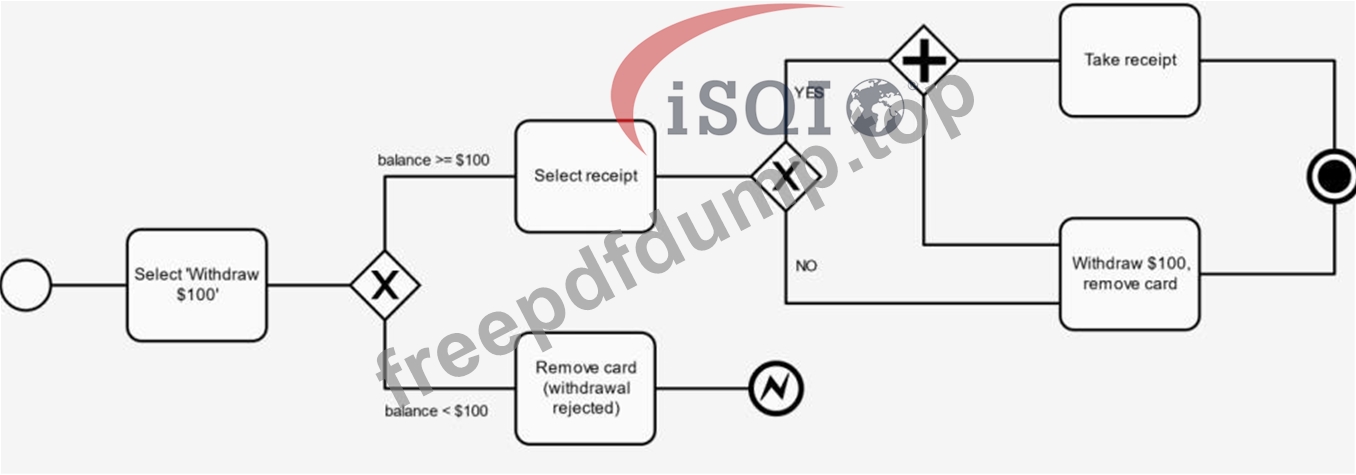
You would like to achieve the following coverage criterion "execute all possible process tasks". Consider the following test cases:
Test 1: balance = $100, receipt = YES
Test 2: balance = $120, receipt = NO
Test 3: balance = $85
Test 4: balance = $20, receipt = YES
Which of the following is the minimal set of test cases allowing to achieve required coverage?
- A. Test 1, Test 3
- B. Test 2, Test 4
- C. Test 1, Test 2, Test 4
- D. Test 1, Test 2, Test 3
Answer: A
Explanation:
Comprehensive Detailed Explanation (Approx. 200-220 words):
This question focuses on the coverage criterion "execute all possible process tasks" from the BPMN model of a $100 withdrawal.
Let's analyze the process:
The process starts when the user selects "Withdraw $100."
A decision gateway checks if the balance is # $100.
If NO: the card is removed and withdrawal is rejected.
If YES: the user is prompted to select whether they want a receipt.
Depending on the user's choice:
If YES: the receipt is printed # then $100 is withdrawn # card is removed.
If NO: $100 is withdrawn # card is removed (no receipt printed).
To meet the criterion "execute all possible process tasks," we must cover:
Rejected withdrawal path (balance < 100)
Withdrawal without receipt
Withdrawal with receipt
Receipt printing
Card removal in both success and failure
Test case coverage:
Test 1 (balance = $100, receipt = YES): covers successful withdrawal + receipt printed.
Test 3 (balance = $85): covers withdrawal rejected + card removed.
Together, these two tests execute all possible process tasks:
Withdraw with receipt
Reject due to insufficient balance
Receipt printed
Withdraw funds
Remove card
Other test combinations are redundant or do not add new path coverage.
NEW QUESTION # 49
Which one of the following statements regarding ATDD / BDD is true?
- A. In Acceptance-Test Driven Development (ATDD., test cases are written prior to the acceptance criteria.
- B. Behavior-Driven Development (BDD. considers acceptance test design as an activity to be handled by the test team after requirements have been finalized.
- C. In both Acceptance-Test Driven Development (ATDD. and Behavior-Driven Development (BDD., acceptance test cases are written by a test automation engineer as test automation code.
- D. In both Acceptance-Test Driven Development (ATDD. and Behavior-Driven Development (BDD., test cases provide examples of product use.
Answer: D
NEW QUESTION # 50
Which one of the following statements describes an exploratory test charter BEST?
- A. Acceptance testers use the exploratory test charter during the testing session to define the test oracle.
- B. The test charter is elaborated during the testing session according to test execution results.
- C. Indicating that the tester should take the role of a novice user can be part of an exploratory test charter.
- D. Each exploratory test charter is based on a previously defined list of activities that would be interesting to test.
Answer: C
Explanation:
An exploratory test charter is a high-level plan or mission statement for a time-boxed exploratory testing session. It guides what the tester should focus on during the session and may include the goal of the test, specific areas of the system under test, the risk or feature to explore, the type of persona to simulate (e.g., novice or expert user), and possibly known issues to watch out for.
Option A is correct because specifying a user persona (such as a novice user) helps the tester approach the system from that perspective. This supports the goal of exploratory testing: to simulate realistic usage and uncover issues that scripted tests might miss.
Option B is incorrect - although exploratory testing is adaptive, the charter is defined before the session starts, not elaborated during execution.
Option C is misleading - charters may refer to areas of interest, but not necessarily to a predefined list of activities.
Option D is incorrect - a test oracle (i.e., the mechanism for determining whether a result is correct) is not defined by the charter. It may exist already or be inferred from requirements, heuristics, or user expectations.
Exact Reference - ISTQB CTFL Acceptance Testing Syllabus (Section 3.1):
"Charters define the focus of exploratory testing sessions and may specify the tester's role or perspective (e.
g., novice user)."
NEW QUESTION # 51
In Agile an exploratory test session is conducted. Which one of the following concepts applies BEST?
- A. pair programming
- B. refactoring
- C. planning poker
- D. timeboxing
Answer: D
NEW QUESTION # 52
Which of the following activities is most likely performed by the business analyst as part of defect analysis?
- A. Identify the requirements / user stories that are not satisfied.
- B. Assess the impact of corrective actions on other parts of the system's implementation.
- C. Analyze the function that failed step by step to identify the cause of the defect.
- D. Check, whether other paths in the business process model perform as intended.
Answer: A
Explanation:
During defect analysis in the context of acceptance testing, the business analyst plays a key role in mapping test results back to business needs and requirements. If a defect is identified during acceptance testing, the business analyst typically evaluates which requirement, user story, or business rule was not fulfilled. This helps determine whether the issue is critical from a business perspective and what corrective action is required.
Option A is correct because it is the primary responsibility of the business analyst to assess unmet requirements or user stories in the event of a defect.
Other options:
B is typically a developer or architect's responsibility, as it involves evaluating the technical impact.
C is part of root cause analysis, usually performed by developers or technical leads.
D refers to broader testing scope and could be part of test analysis but is less specific to the business analyst's role in defect analysis.
NEW QUESTION # 53
As a tester you are part of a development team for health monitoring system to record and synchronize various health parameters, calculate health score and provide practical advice on how to maintain and improve health. You are asked to review the acceptance criteria for the following user story:
US23; As a user of the system. I can monitor my blood pressure and obtain alerts in case of excessive pressure, in order to prevent the risk associated with hypertension.
Which of the following is NOT a good example of an acceptance criterion for this requirement?
- A. The monitoring system displays the heart rate together with the blood pressure
- B. The alert thresholds depend on the following user's personal settings: age, weight and gender
- C. People with hypertension are advised to get their blood pressure checked at least thrice a week
- D. The system should be developed using Java script framework to allow fast response times
Answer: D
Explanation:
Acceptance criteria describe what the system must do to fulfill a requirement from the user or business perspective. They must be observable, testable, and relevant to the business outcome or expected behavior.
In this scenario, the user story is about monitoring blood pressure and receiving alerts for excessive pressure.
The acceptance criteria should focus on system behavior, thresholds, and how alerts are triggered based on user settings.
Option D is not a good acceptance criterion because:
It specifies a technical implementation detail (JavaScript framework), which is not the concern of acceptance testing.
Acceptance criteria should not prescribe how the system is built, but what it must do from a business or user point of view.
Other options (A, B, and C) all reflect testable and behavior-focused outcomes linked to the user story's goal.
D). The system should be developed using JavaScript framework to allow fast response times
NEW QUESTION # 54
Which of the following information is most likely part of an acceptance test summary report?
- A. Test strategy and test design methods.
- B. Technical details on defect fixes.
- C. Information to evaluate the level of risk for product release.
- D. Test procedure information.
Answer: C
Explanation:
An acceptance test summary report is a high-level document produced at the end of acceptance testing. It provides stakeholders (especially business owners and decision-makers) with essential information to determine whether the system meets the acceptance criteria and whether it is ready for release.
Option A is correct because understanding the residual risk - based on test results, open defects, and coverage - is critical for release decisions. The summary report includes test execution status, significant findings, defect summaries, and an overall risk assessment.
Other options:
B (technical details on defect fixes) belong more in defect or technical reports, not in the acceptance summary.
C (test strategy/design methods) are part of the test plan, not the summary report.
D (test procedure info) is operational detail, not suited for a high-level summary report.
A). Information to evaluate the level of risk for product release.
NEW QUESTION # 55
What is considered as good practice regarding business process modeling?
- A. BPMN diagrams and DMN tables should include information such as traceability to user stories.
- B. Keeping all model element in one diagram considerably improves the readability of BMPN models.
- C. Business analysts should finalize their process models before showing them to acceptance testers.
- D. Links to requirements or risks should be well separated from the workflow description.
Answer: A
NEW QUESTION # 56
You recently became an acceptance tester in a cross-discipline project, because your predecesor left the company over nogth. The 15 project team members are located in different time zones. Everybody seems to work hard on their tasks, but nobody can give you with an overview on the project.
What one of the following actions is BEST to encourage the team members to work closer together?
- A. You establish a test management tool to make sure everybody has Access to the requirements and their related test cases.
- B. You organize a workshop with all team members to establish common understanding and to lay the foundation for fruitful trusting collaboration
- C. Knowing about the importance of the personal interactions, you travel from site to site to meet with every project team member and collect their vision
- D. You write a long e-mail summarizing your understanding of the project goals, its current difficulties and indicate the steps required to solve the problem.
Answer: B
Explanation:
In cross-functional, globally distributed teams, establishing collaboration, communication, and trust is key. A workshop (even virtual) is a proven method for initiating alignment, especially when a new team member joins, and project coordination is weak.
Option A promotes transparency and collective understanding, crucial for building team cohesion.
Option B is too passive and one-directional. Long emails rarely solve coordination problems in Agile or collaborative contexts.
Option C is about tool setup, not team integration or communication - tools are supportive but not substitutes for human connection.
Option D is not efficient; traveling to meet each team member is impractical and doesn't guarantee a shared team vision.
A). You organize a workshop with all team members to establish common understanding and to lay the foundation for fruitful trusting collaboration.
NEW QUESTION # 57
......
ISQI Certified CTFL-AcT Dumps Questions Valid CTFL-AcT Materials: https://pass4sures.freepdfdump.top/CTFL-AcT-valid-torrent.html
