

Prepare for your exam certification with our DP-600 Certified Microsoft
Free Microsoft DP-600 Exam 2026 Practice Materials Collection
NEW QUESTION # 82
You have source data in a folder on a local computer.
You need to create a solution that will use Fabric to populate a data store. The solution must meet the following requirements:
* Support the use of dataflows to load and append data to the data store.
* Ensure that Delta tables are V-Order optimized and compacted automatically.
Which type of data store should you use?
- A. a KQL database
- B. a lakehouse
- C. a warehouse
- D. an Azure SQL database
Answer: C,D
Explanation:
A lakehouse (A) is the type of data store you should use. It supports dataflows to load and append data and ensures that Delta tables are Z-Order optimized and compacted automatically. Reference = The capabilities of a lakehouse and its support for Delta tables are described in the lakehouse and Delta table documentation.
NEW QUESTION # 83
You have a Fabric tenant that contains a warehouse.
Several times a day. the performance of all warehouse queries degrades. You suspect that Fabric is throttling the compute used by the warehouse.
What should you use to identify whether throttling is occurring?
- A. the Microsoft Fabric Capacity Metrics app
- B. dynamic management views (DMVs)
- C. the Capacity settings
- D. the Monitoring hub
Answer: D
Explanation:
To identify whether throttling is occurring, you should use the Monitoring hub (B). This provides a centralized place where you can monitor and manage the health, performance, and reliability of your data estate, and see if the compute resources are being throttled. References = The use of the Monitoring hub for performance management and troubleshooting is detailed in the Azure Synapse Analytics documentation.
NEW QUESTION # 84
You have a Fabric tenant that contains a lakehouse named Lakehouse1. Lakehouse1 contains a table named Nyctaxi_raw. Nyctaxi_raw contains the following columns.
You create a Fabric notebook and attach it to lakehouse1.
You need to use PySpark code to transform the data. The solution must meet the following requirements:
* Add a column named pickupDate that will contain only the date portion of pickupDateTime.
* Filter the DataFrame to include only rows where fareAmount is a positive number that is less than 100.
How should you complete the code? To answer, select the appropriate options in the answer area. NOTE: Each correct selection is worth one point.
Answer:
Explanation:
Explanation:
* Add the pickupDate column: .withColumn("pickupDate", df["pickupDateTime"].cast("date"))
* Filter the DataFrame: .filter("fareAmount > 0 AND fareAmount < 100")
In PySpark, you can add a new column to a DataFrame using the .withColumn method, where the first argument is the new column name and the second argument is the expression to generate the content of the new column. Here, we use the .cast("date") function to extract only the date part from a timestamp. To filter the DataFrame, you use the .filter method with a condition that selects rows where fareAmount is greater than 0 and less than 100, thus ensuring only positive values less than 100 are included.
NEW QUESTION # 85
You have a Fabric tenant that contains a lakehouse named Lakehouse1. Lakehouse1 contains a table named Nyctaxi_raw. Nyctaxi_raw contains the following columns.
You create a Fabric notebook and attach it to lakehouse1.
You need to use PySpark code to transform the data. The solution must meet the following requirements:
* Add a column named pickupDate that will contain only the date portion of pickupDateTime.
* Filter the DataFrame to include only rows where fareAmount is a positive number that is less than 100.
How should you complete the code? To answer, select the appropriate options in the answer area. NOTE:
Each correct selection is worth one point.
Answer:
Explanation:
Explanation:
Add the pickupDate column: .withColumn("pickupDate", df["pickupDateTime"].cast("date")) Filter the DataFrame: .filter("fareAmount > 0 AND fareAmount < 100") In PySpark, you can add a new column to a DataFrame using the .withColumn method, where the first argument is the new column name and the second argument is the expression to generate the content of the new column. Here, we use the .cast("date") function to extract only the date part from a timestamp. To filter the DataFrame, you use the .filter method with a condition that selects rows where fareAmount is greater than 0 and less than 100, thus ensuring only positive values less than 100 are included.
NEW QUESTION # 86
You have a Fabric tenant tha1 contains a takehouse named Lakehouse1. Lakehouse1 contains a Delta table named Customer.
When you query Customer, you discover that the query is slow to execute. You suspect that maintenance was NOT performed on the table.
You need to identify whether maintenance tasks were performed on Customer.
Solution: You run the following Spark SQL statement:
REFRESH TABLE customer
Does this meet the goal?
- A. No
- B. Yes
Answer: A
NEW QUESTION # 87
You have a Fabric tenant that contains two workspaces named Woritspace1 and Workspace2. Workspace1 contains a lakehouse named Lakehouse1. Workspace2 contains a lakehouse named Lakehouse2. Lakehouse!
contains a table named dbo.Sales. Lakehouse2 contains a table named dbo.Customers.
You need to ensure that you can write queries that reference both dbo.Sales and dbo.Customers in the same SQL query without making additional copies of the tables.
What should you use?
- A. a managed table
- B. a view
- C. a dataflow
- D. a shortcut
Answer: D
Explanation:
In Microsoft Fabric, a shortcut lets you reference data from another workspace's Lakehouse or external storage without duplicating the data.
A view would only apply within the same database/Lakehouse, not across workspaces.
A dataflow transforms and loads data but creates a new copy.
A managed table is a physical table stored in the Lakehouse itself, not a cross-reference.
So, to query dbo.Sales (Lakehouse1) and dbo.Customers (Lakehouse2) in a single SQL query, you use shortcuts.
Reference: Shortcuts in OneLake
NEW QUESTION # 88
You have a Microsoft Power Bl semantic model.
You plan to implement calculation groups.
You need to create a calculation item that will change the context from the selected date to month-to-date (MTD).
How should you complete the DAX expression? To answer, select the appropriate options in the answer area.
NOTE: Each correct selection is worth one point.
Answer:
Explanation:
Explanation:
To create a calculation item that changes the context from the selected date to month-to-date (MTD), the appropriate DAX expression involves using the CALCULATE function to alter the filter context and the DATESMTD function to specify the month-to-date context.
The correct completion for the DAX expression would be:
* In the first dropdown, select CALCULATE.
* In the second dropdown, select SELECTEDMEASURE.
This would create a DAX expression in the form:
CALCULATE(
SELECTEDMEASURE(),
DATESMTD('Date'[DateColumn])
)
NEW QUESTION # 89
Drag and Drop Question
You create a semantic model by using Microsoft Power BI Desktop. The model contains one security role named SalesRegionManager and the following tables:
- Sales
- SalesRegion
- SalesAddress
You need to modify the model to ensure that users assigned the SalesRegionManager role cannot see a column named Address in SalesAddress.
Which three actions should you perform in sequence? To answer, move the appropriate actions from the list of actions to the answer area and arrange them in the correct order.
Answer:
Explanation:
Explanation:
https://learn.microsoft.com/en-us/fabric/security/service-admin-object-level-security?tabs=table
NEW QUESTION # 90
You have a Fabric tenant.
You plan to create a Fabric notebook that will use Spark DataFrames to generate Microsoft Power Bl visuals.
You run the following code.
For each of the following statements, select Yes if the statement is true. Otherwise, select No. NOTE: Each correct selection is worth one point.
Answer:
Explanation: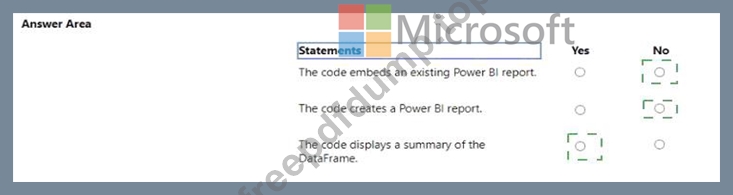
Explanation:
* The code embeds an existing Power BI report. - No
* The code creates a Power BI report. - Yes
* The code displays a summary of the DataFrame. - Yes
The code provided seems to be a snippet from a SQL query or script which is neither creating nor embedding a Power BI report directly. It appears to be setting up a DataFrame for use within a larger context, potentially for visualization in Power BI, but the code itself does not perform the creation or embedding of a report. Instead, it's likely part of a data processing step that summarizes data.
References =
* Introduction to DataFrames - Spark SQL
* Power BI and Azure Databricks
NEW QUESTION # 91
You have a Fabric warehouse named Warehousel that contains a table named Table! Tablel contains customer data.
You need to implement row-level security (RLS) for Tablel. The solution must ensure that users can see only their respective data.
Which two objects should you create? Each correct answer presents part of the solution.
NOTE: Each correct selection is worth one point.
- A. CONSTRAINT
- B. DATABASE ROLE
- C. FUNCTION
- D. STORED PROCEDURE
- E. SECURITY POLICY
Answer: C,E
Explanation:
To implement row-level security (RLS) in a Fabric Warehouse (like in Azure Synapse or SQL Server):
You must define a predicate function (usually an inline table-valued function) that filters rows for each user
# Function.
Then you bind that function to the table using a Security Policy # Security Policy.
A Database Role is used for group-based access control but not specifically for implementing RLS.
Stored procedures and constraints are not used for RLS.
Correct answers: A and D
eference: Row-Level Security (RLS) in Synapse/Fabric SQL
NEW QUESTION # 92
You have an Amazon Web Services (AWS) subscription that contains an Amazon Simple Storage Service (Amazon S3) bucket named bucketl.
You have a Fabric tenant that contains a lakehouse named LH1.
In LH1, you plan to create a OneLake shortcut to bucketl.
You need to configure authentication for the connection.
Which two values should you provide? Each correct answer presents part of the solution.
NOTE: Each correct selection is worth one point.
- A. the access key ID
- B. the secret access key
- C. the access ID
- D. the shared access signature (SAS) token
- E. the certificate thumbprint
Answer: A,B
Explanation:
When creating a OneLake shortcut to Amazon S3, authentication uses the standard AWS access key ID + secret access key pair.
SAS token is for Azure Storage, not AWS.
Certificate thumbprint is not used for S3.
Access ID is incorrect naming; the correct term is access key ID.
Correct answers: B and D.
Reference: Create shortcuts to Amazon S3 in OneLake
NEW QUESTION # 93
You to need assign permissions for the data store in the AnalyticsPOC workspace. The solution must meet the security requirements.
Which additional permissions should you assign when you share the data store? To answer, select the appropriate options in the answer area.
NOTE: Each correct selection is worth one point.
Answer:
Explanation:
NEW QUESTION # 94
You have a Fabric tenant
You plan to create a data pipeline named Pipeline1. Pipeline1 will include two activities that will execute in sequence. You need to ensure that a failure of the first activity will NOT block the second activity. Which conditional path should you configure between the first activity and the second activity?
- A. Upon Success
- B. Upon Skip
- C. Upon Failure
- D. Upon Completion
Answer: D
Explanation:
Upon Success: downstream runs only if the first activity succeeds.
Upon Failure: downstream runs only if the first activity fails.
Upon Skip: downstream runs if the activity was skipped.
Upon Completion: downstream runs regardless of whether the first activity succeeded or failed.
Since we want the second activity to run even if the first fails, the correct answer is Upon Completion.
Reference: Pipeline activity dependencies in Fabric Data Factory
NEW QUESTION # 95
You have a Fabric tenant that contains 30 CSV files in OneLake. The files are updated daily.
You create a Microsoft Power Bl semantic model named Modell that uses the CSV files as a data source. You configure incremental refresh for Model 1 and publish the model to a Premium capacity in the Fabric tenant.
When you initiate a refresh of Model1, the refresh fails after running out of resources.
What is a possible cause of the failure?
- A. Only refresh complete days is selected.
- B. The data type of the column used to partition the data has changed.
- C. XMLA Endpoint is set to Read Only.
- D. Query folding is occurring.
- E. Query folding is NOT occurring.
Answer: E
Explanation:
A possible cause for the failure is that query folding is NOT occurring (D). Query folding helps optimize refresh by pushing down the query logic to the source system, reducing the amount of data processed and transferred, hence conserving resources. Reference = The Power BI documentation on incremental refresh and query folding provides detailed information on this topic.
NEW QUESTION # 96
You have source data in a folder on a local computer.
You need to create a solution that will use Fabric to populate a data store. The solution must meet the following requirements:
* Support the use of dataflows to load and append data to the data store.
* Ensure that Delta tables are V-Order optimized and compacted automatically.
Which type of data store should you use?
- A. a KQL database
- B. a lakehouse
- C. a warehouse
- D. an Azure SQL database
Answer: B
NEW QUESTION # 97
You have a Fabric tenant that contains a lakehouse.
You are using a Fabric notebook to save a large DataFrame by using the following code.
For each of the following statements, select Yes if the statement is true. Otherwise, select No.
NOTE: Each correct selection is worth one point.
Answer:
Explanation:
Explanation:
* The results will form a hierarchy of folders for each partition key. - Yes
* The resulting file partitions can be read in parallel across multiple nodes. - Yes
* The resulting file partitions will use file compression. - No
Partitioning data by columns such as year, month, and day, as shown in the DataFrame write operation, organizes the output into a directory hierarchy that reflects the partitioning structure. This organization can improve the performance of read operations, as queries that filter by the partitioned columns can scan only the relevant directories. Moreover, partitioning facilitates parallelism because each partition can be processed independently across different nodes in a distributed system like Spark. However, the code snippet provided does not explicitly specify that file compression should be used, so we cannot assume that the output will be compressed without additional context.
References =
* DataFrame write partitionBy
* Apache Spark optimization with partitioning
NEW QUESTION # 98
You have a Fabric tenant that contains a lakehouse named Lakehouse1
Readings from 100 loT devices are appended to a Delta table in Lakehouse1. Each set of readings is approximately 25 KB. Approximately 10 GB of data is received daily.
All the table and SparkSession settings are set to the default.
You discover that queries are slow to execute. In addition, the lakehouse storage contains data and log files that are no longer used.
You need to remove the files that are no longer used and combine small files into larger files with a target size of 1 GB per file.
What should you do? To answer, drag the appropriate actions to the correct requirements. Each action may be used once, more than once, or not at all. You may need to drag the split bar between panes or scroll to view content.
NOTE: Each correct selection is worth one point.
Answer:
Explanation:
Explanation:
* Remove the files: Run the VACUUM command on a schedule.
* Combine the files: Set the optimizeWrite table setting. or Run the OPTIMIZE command on a schedule.
To remove files that are no longer used, the VACUUM command is used in Delta Lake to clean up invalid files from a table. To combine smaller files into larger ones, you can either set the optimizeWrite setting to combine files during write operations or use the OPTIMIZE command, which is a Delta Lake operation used to compact small files into larger ones.
NEW QUESTION # 99
You have a Fabric tenant that contains a semantic model named Model1. Model1 uses Import mode. Model1 contains a table named Orders. Orders has 100 million rows and the following fields.
You need to reduce the memory used by Model! and the time it takes to refresh the model. Which two actions should you perform? Each correct answer presents part of the solution. NOTE: Each correct answer is worth one point.
- A. Replace TotalQuantity with a calculated column.
- B. Replace TotalSalesAmount with a measure.
- C. Convert Quantity into the Text data type.
- D. Split OrderDateTime into separate date and time columns.
Answer: A,B
Explanation:
To reduce memory usage and refresh time, splitting the OrderDateTime into separate date and time columns (A) can help optimize the model because date/time data types can be more memory-intensive than separate date and time columns. Moreover, replacing TotalSalesAmount with a measure (D) instead of a calculated column ensures that the calculation is performed at query time, which can reduce the size of the model as the value is not stored but calculated on the fly. References = The best practices for optimizing Power BI models are detailed in the Power BI documentation, which recommends using measures for calculations that don't need to be stored and adjusting data types to improve performance.
NEW QUESTION # 100
You have an Azure Repos Git repository named Repo1 and a Fabric-enabled Microsoft Power Bl Premium capacity. The capacity contains two workspaces named Workspace! and Workspace2. Git integration is enabled at the workspace level.
You plan to use Microsoft Power Bl Desktop and Workspace! to make version-controlled changes to a semantic model stored in Repo1. The changes will be built and deployed lo Workspace2 by using Azure Pipelines.
You need to ensure that report and semantic model definitions are saved as individual text files in a folder hierarchy. The solution must minimize development and maintenance effort.
In which file format should you save the changes?
- A. PBIT
- B. PBIDS
- C. PBIX
- D. PBIP
Answer: C
Explanation:
When working with Power BI Desktop and Git integration for version control, report and semantic model definitions should be saved in the PBIX format. PBIX is the Power BI Desktop file format that contains definitions for reports, data models, and queries, and it can be easily saved and tracked in a version-controlled environment. The solution should minimize development and maintenance effort, and saving in PBIX format allows for the easiest transition from development to deployment, especially when using Azure Pipelines for CI/CD (continuous integration/continuous deployment) practices.
References: The use of PBIX files with Power BI Desktop and Azure Repos for version control is discussed in Microsoft's official Power BI documentation, particularly in the sections covering Power BI Desktop files and Azure DevOps integration.
NEW QUESTION # 101
......
Pass Microsoft DP-600 Actual Free Exam Q&As Updated Dump: https://pass4sures.freepdfdump.top/DP-600-valid-torrent.html
